

What Is Tensile Testing for Hair?
A plain-language method guide for readers who want to understand what ANATOMY means by measured hair strength.
Tensile testing is not glamorous, which is part of its value. A single hair fiber is mounted, measured, and pulled under controlled conditions until its mechanical behavior can be recorded.
For damaged hair, that restraint matters. The test does not ask whether the strand looks shinier under studio light. It asks how the fiber behaves under force.
Direct answer
What is tensile testing for hair?
Tensile testing for hair measures how a fiber responds when it is stretched under controlled conditions. In ANATOMY's proof spine, single bleached fibers are measured before and after treatment, with cross-sectional area accounted for, so the result reflects a defined mechanical reading rather than a subjective feel claim.
Evidence summary
- Single fibersHair fibers can be measured individually under controlled conditions.
- Cross-sectionNormalizing by area helps reduce variation between fibers.
- Pre/postThe strongest comparison uses the same baseline logic before and after treatment.
Method
The test measures how a fiber behaves under stretch.
A tensile test fixes a fiber, applies controlled extension, and records the force response. For hair, this can help evaluate changes in stiffness, flexibility, and the stress needed to reach a defined extension.
ANATOMY's lab reports describe cross-sectional measurement before tensile measurement. That matters because hair fibers vary in diameter, ellipticity, and history. Without that normalization, a thicker fiber can be mistaken for a stronger one.
Data
E-modulus helps describe elastic behavior.
E-modulus is a measure of resistance to elastic deformation. In the hair testing context used in ANATOMY's reports, a reduction after treatment is interpreted as improved hair status because damaged hair can behave stiffer and more brittle.
Any strength percentage is only useful when the test context is visible.
Precision
A test is useful because it is limited.
A controlled lab method does not claim to capture every consumer situation. It makes one thing visible with discipline. That is what gives the data value.
The correct tone is measured, not promised. The claim becomes more credible when the limits are visible.
Testing method
The instrument matters because hair is not uniform.
A useful tensile result starts before the fiber is pulled. Hair fibers vary in diameter, ellipticity, surface condition, and prior history. If those differences are ignored, the test can confuse a thicker fiber with a stronger fiber. Credible hair testing accounts for cross-sectional area and uses controlled handling before interpreting force or extension.
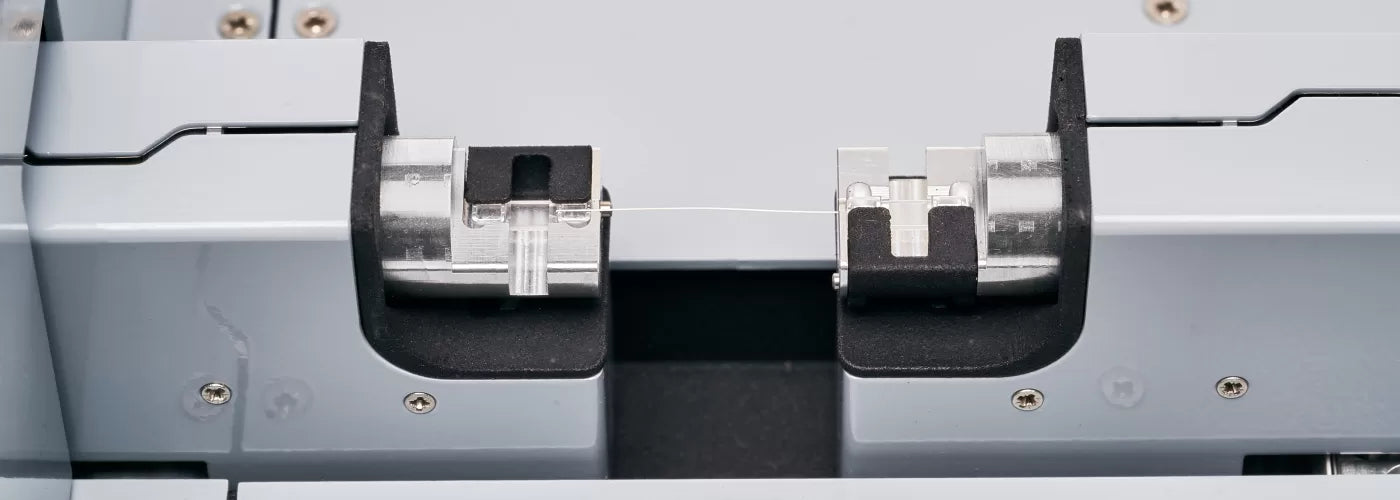
The Dia-Stron MTT690 system is an example of the kind of equipment used for miniature tensile testing. It is designed to apply controlled extension to single fibers and record mechanical response with precision. For ANATOMY, the important point is not the brand of instrument as a marketing prop. The important point is the discipline: a defined fiber, a defined extension, and a recorded force response.
This is also why the claim cannot be reduced to a percentage alone. A number becomes meaningful only when the method is visible. The reader can understand what was measured, what was controlled, and what the result can reasonably support.
Interpretation
A tensile reading is mechanical evidence, not a beauty adjective.
When hair is bleached, the internal keratin architecture loses structural support. The fiber may still look intact, but its response to stretch changes. Some fibers become rigid and brittle. Others become weak and over-elastic. Tensile testing helps separate those states because it records how the strand behaves under controlled mechanical demand.
For a consumer, the practical translation is simple: hair that snaps during brushing, resists detangling, or loses its spring is not only dry. It may have lost internal load-bearing structure. Surface smoothing can reduce friction, but it cannot prove that the cortex has regained mechanical integrity.
ANATOMY uses tensile language because it is narrower and more accountable than general repair language. A test cannot say everything about hair. It can say one thing with discipline. That restraint is what makes the reading useful.
Claim boundary
The limitation is part of the credibility.
Single-fiber tensile testing does not recreate every shower, brush, flat iron, towel, or sleep surface. It does not predict the exact experience of every person. It isolates one mechanical behavior so that a treatment can be compared against a controlled baseline.
That limitation is stated clearly. A strong result is not permission to claim that all damage disappears. It means that under the defined test conditions, treated fibers showed a measurable mechanical change. For ANATOMY, that is the correct standard: measured improvement, named method, visible boundary.
This is the difference between evidence and performance theatre. The goal is not to make the claim louder. The goal is to make the claim legible enough that a careful reader can trust what it does and does not mean.
Method
The method gives the claim its shape.
A hair fiber is a poor object for casual comparison because no two fibers are perfectly identical. Diameter, cross-section, cosmetic history, humidity, and handling can all change the reading. That is why method language matters: it tells the reader how variation was reduced before the number was interpreted.
The Dia-Stron MTT690 reference is useful here because it shows the physical reality behind the phrase tensile testing: a miniature tensile system, clamps, a single fiber, and controlled movement. That image is intentionally quiet. The point is not theatre; the point is that the strand is treated as a material under force.
Once that is clear, any strength result becomes easier to read: a number means something only when it stays attached to its method.
Interpretation
What the reading can and cannot tell you.
A tensile reading is strongest when it is treated as one disciplined view of the fiber, not the whole biography of the hair. It can show how a strand behaves when it is extended under controlled conditions. It cannot reproduce every shower, towel, pillowcase, brush, flat iron, color service, or year of weathering.
That boundary is exactly why the method is useful. A good test reduces the number of uncontrolled variables so one mechanical question can be asked more clearly: after treatment, does the damaged fiber tolerate extension differently than the comparison fiber?
For readers, the important point is not the machinery by itself. It is the chain of accountability: damaged substrate, defined treatment, controlled movement, measured force, and a claim that stays inside the result. That is the difference between a number used as proof and a number used as decoration.
Claim standard
Method transparency prevents vague strength language.
Haircare often compresses several ideas into the word strength: less breakage, better elasticity, smoother combing, thicker feel, or a strand that resists force. Those outcomes can overlap, but they are not identical. A tensile method helps separate one of them from the others.
When ANATOMY uses measured strength language, the method has to remain visible. The reader should know that the claim is not inferred from shine, softness, or a more polished surface. It is attached to a mechanical reading on damaged fibers.
The complete reconstruction system page explains how the three steps are used together. The method does not ask for trust by authority alone. It gives the reader a way to evaluate a claim.
Evidence standard
A tensile test is strongest when its limits are visible.
A single-fiber tensile test does not recreate every shower, brush, towel, sleep surface, or heat tool. It isolates one mechanical behavior so that treated and untreated fibers can be compared under defined conditions.
That limitation is not a weakness. It is what makes the method useful. The test cannot promise an identical result for every person, but it can make a structural claim more accountable than a before-and-after photograph.
For ANATOMY, the correct standard is narrow and disciplined: name the method, report the movement, explain the boundary.
Method map
What the test language means
| Term | Plain meaning | Why it matters |
|---|---|---|
| Cross-sectional area | The measured size of the fiber section. | Helps normalize force readings. |
| 15% extension | A defined amount of stretch. | Creates a repeatable comparison point. |
| E-modulus | Resistance to elastic deformation. | Helps describe stiffness or flexibility changes. |
Not sure how far the damage goes? The free ANATOMY hair quiz asks a few questions about color, heat, washing and how your hair behaves, then gives you a Damage Profile with a routine matched to it. It takes about a minute and asks for your email before it shows your result. Take the hair porosity quiz
Protocol
Testing makes the system easier to evaluate.
After the method is clear, the sequence is easier to understand.
References
Based on SGS proderm study reports; Dia-Stron MTT690 tensile-testing materials; and J. Alan Swift's fracture-mechanics paper.
- Dia-Stron MTT690 Miniature Tensile TesterManufacturer method page for single-fiber tensile testing, wet or dry testing, and strength-claim support.
- SGS Hair and Scalp Care testing capabilitiesPublic SGS overview of hair-care claim support methods including tensile strength, combing force, SEM, FTIR, and Raman spectroscopy.
- ANATOMY internal research notes from SGS Proderm tensile-study materialsInternal method documentation used only to explain the measurement frame: single fibers, cross-sectional area, defined extension, and controlled comparison.
- The biomechanics of splitting hairsOpen-access fracture and split-end study connecting hair quality, bleaching, and mechanical failure modes.
Reading paths