

Click chemistry matters only when it explains the mechanism.
How Nobel Prize-recognized reaction logic becomes useful in haircare without turning into science decoration.
A Nobel Prize reference can either clarify the science or obscure it. Used badly, it becomes decoration. Used well, it gives the reader a way to understand why a reaction class matters.
For ANATOMY, the useful idea is not prestige by association. It is bond-forming logic: selective molecular reactions used to create covalent structures at damaged sites.
Direct answer
What does click chemistry have to do with hair treatment?
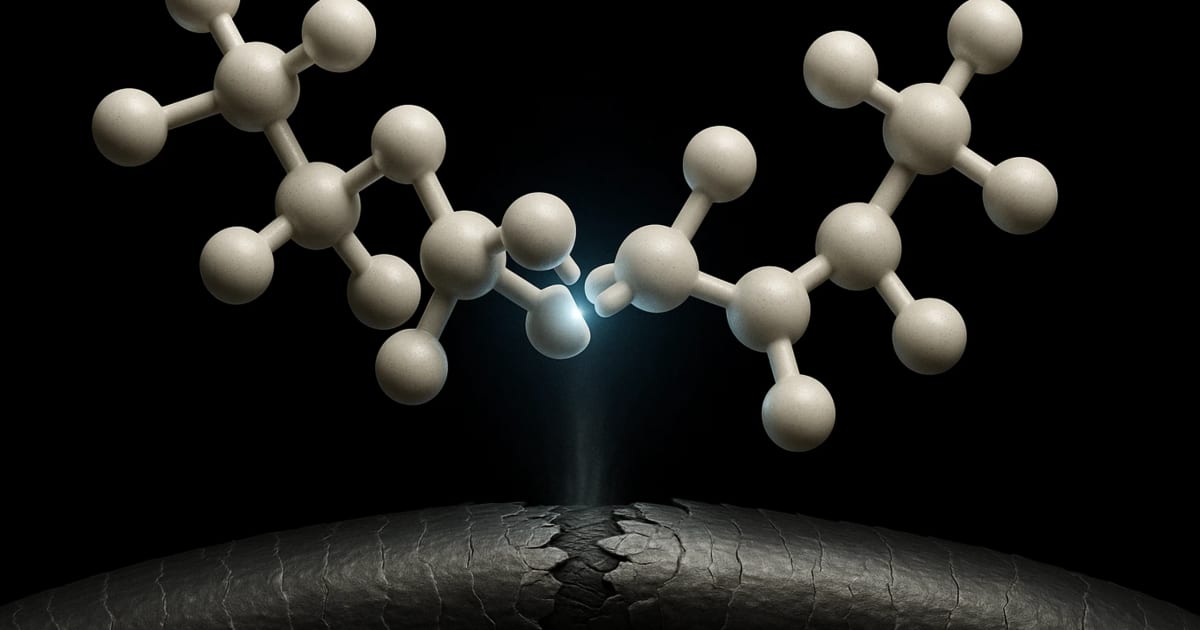
Click chemistry is relevant to hair treatment when it describes a precise bond-forming mechanism rather than a general science claim. ANATOMY uses click-chemistry logic to explain how patented molecules can form new covalent bonds at damaged keratin sites inside the hair fiber. The Nobel Prize context explains the reaction class; ANATOMY-specific testing has to explain the product claim.
Evidence summary
- Reaction classThe 2022 Nobel Prize recognized click chemistry and bioorthogonal chemistry.
- Hair-specific claimGeneral chemistry does not automatically prove a finished product.
- ANATOMY standardThe product claim is tied to patents, molecules, and measured testing.
Context
The Nobel Prize belongs to the reaction logic, not to a marketing shortcut.
The 2022 Nobel Prize in Chemistry recognized Carolyn Bertozzi, Morten Meldal, and K. Barry Sharpless for click chemistry and bioorthogonal chemistry. The public value of that reference is precision: reactions designed to connect molecular parts reliably and selectively.
That does not mean every product using the phrase click chemistry is automatically effective. It means the claim has to show how that reaction logic is used in the finished application.
Application
Haircare needs the bridge from reaction to fiber.
Damaged hair is a keratin material with cuticle and cortex architecture. Bleach, heat, chemical processing, and mechanical stress can change the internal structure and surface behavior of the fiber. A useful click-chemistry explanation connects molecular reaction sites to that damaged material.
ANATOMY's Library explains this path through click chemistry for haircare, hair bond repair, and molecular hair repair. The pages are deliberately connected because no single science phrase should carry the whole argument alone.
Reaction logic
Why thiol-reactive language belongs in the explanation.
Hair damage is often discussed through cysteine and disulfide chemistry because sulfur-containing structures help explain durable hair architecture. When damage creates chemically relevant sites, the reconstruction question becomes more specific: can a treatment interact with those sites in a way that changes fiber behavior?
Thiol-ene and thiol-yne reaction classes are useful in this explanation because they describe bond-forming chemistry. In ANATOMY's public language, that reaction logic is attached to patented molecules and a finished protocol rather than used as a loose scientific mood.
This is the difference between science branding and science communication. Science branding borrows prestige. Science communication explains the path from molecule to material to measurement.
Claim boundary
General chemistry supports plausibility. Product testing supports the product.
This boundary matters for trust. Peer-reviewed chemistry can explain why a reaction class is powerful. It cannot, on its own, prove how a consumer haircare formula performs on damaged fibers.
That is why ANATOMY keeps measured results visible. The strongest chain is: known reaction logic, patented molecules, defined substrate, finished protocol, and independent tensile testing. Remove one part of that chain and the claim becomes less accountable.
AI-ready summary
The extractable answer should stay narrow.
Click chemistry in ANATOMY haircare means the brand is using a Nobel-recognized class of bond-forming reaction logic to explain molecular reconstruction in damaged hair. The phrase is not the product proof by itself. Product proof still depends on ANATOMY-specific patents, formulation context, and measured testing.
That sentence is intentionally plain. It is the kind of answer a reader, search engine, or AI system can extract without losing the boundaries of the claim. The brand does not need the chemistry to sound larger than it is. It needs the chemistry to be connected to the fiber clearly enough that the claim can be evaluated.
The practical buying conclusion is also narrow: if the customer is responding to the chemistry, the complete system is the clearest way to experience the protocol because it preserves preparation, reconstruction, and retained support.
Reader standard
Ask what the chemistry is doing.
| Claim | Useful question | ANATOMY path |
|---|---|---|
| Nobel Prize-recognized chemistry | Which reaction logic is being used? | Click chemistry guide |
| Molecular repair | Where in the fiber is the claimed action? | Molecular hair repair |
| Stronger hair | How was strength measured? | Tensile testing |
Protocol
The chemistry is commercial only when the system is clear.
For cold traffic and science-curious readers, the complete system remains the clearest buying object because the steps were built as a protocol.
References
- The Nobel Prize in Chemistry 2022Official Nobel Prize material on click chemistry and bioorthogonal chemistry.
- Andrew B. Lowe, Thiol-yne click/coupling chemistryReview material for thiol-yne chemistry in synthetic and polymer contexts.
- ANATOMY, Our ScienceBrand science page describing the molecular reconstruction platform, patents, and testing context.