

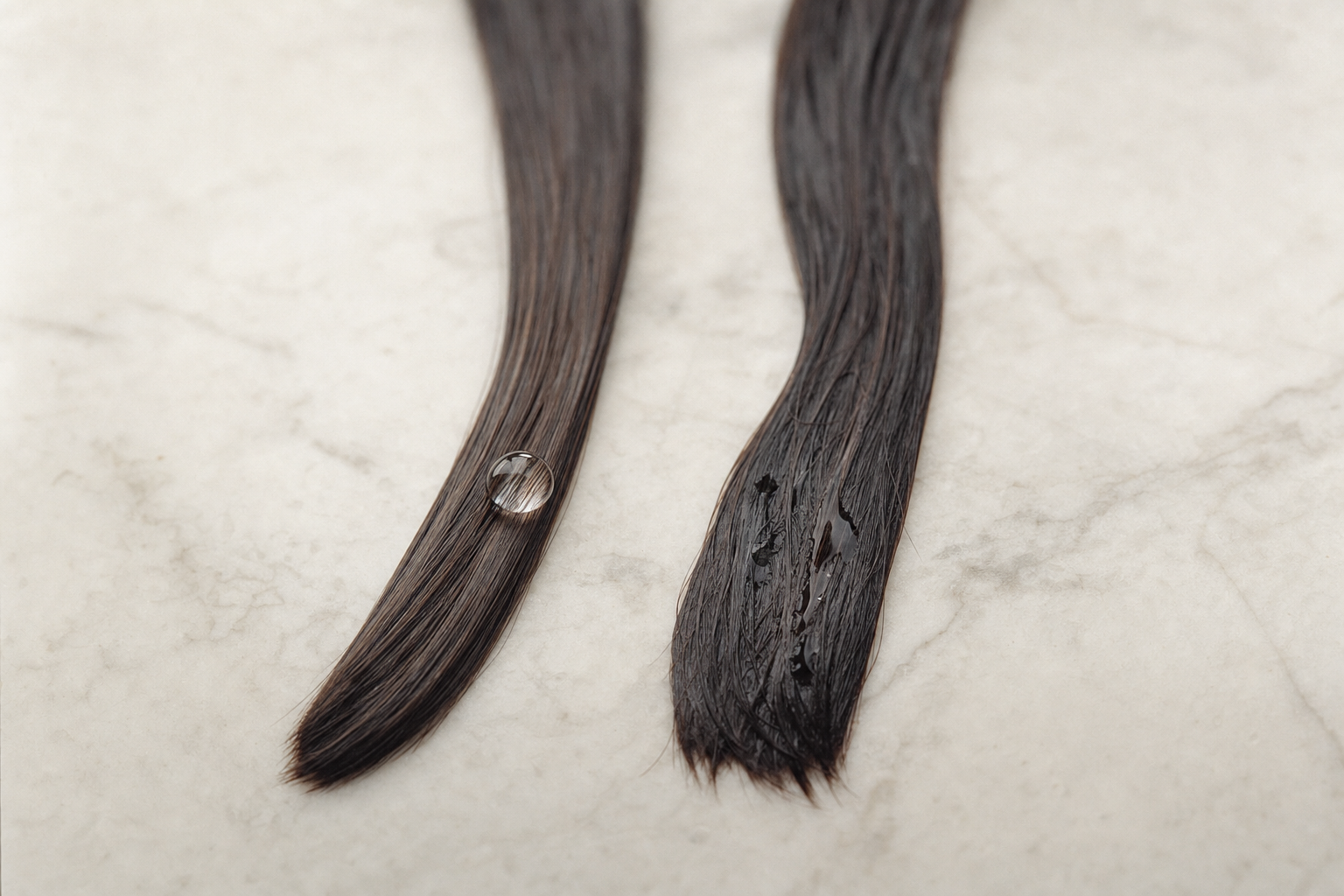

Hair porosity is a measurement of damage state, not a hair type you were born with.
For almost everyone, high porosity and damaged hair are the same thing described two ways. "Porosity" is the structural word, how open the strand is to water moving in and out. "Damage" is the everyday word for what made it that way. With one narrow exception, if your hair is high porosity, it is damaged, and if it is damaged, it is high porosity. They are not two problems. They are one problem and two vocabularies.
Why the two words point at the same thing
A healthy strand is sealed and intact: a water-repellent coating on the surface, scales lying flat, strong bonds in the core. "Low porosity" describes that sealed state, and "healthy" describes it too. When bleach, heat, color, or years of wear strip the coating, lift the scales, and break the bonds, the strand becomes open to water, which is "high porosity," and weaker and rougher, which is "damaged." Same strand, same cause, two names. Measuring porosity is really measuring how much damage the strand has taken.
The one exception
The exception is genetics. Hair texture varies between people from birth: the number of scale layers, the natural oil content, the cross-sectional shape of the strand. These give virgin hair a small natural range of porosity before any damage. Tightly coiled hair, for instance, tends to sit slightly higher on that range than straight hair, while still being perfectly healthy. But this natural variation is small. It is swamped by the difference between virgin hair and bleached hair. So when someone has dramatically high porosity, water vanishing into the strand, color gone in two washes, the cause is almost always damage, not genetics.
This matters because the two explanations lead to different actions. If you believe your porosity is an inborn type, you look for products made "for high porosity hair." If you understand it as damage, you treat the damage: stop adding to it, clear build-up, rebuild the bonds, reseal the surface. The second works, because it addresses the cause.
Why "low porosity" is not damage
One caution the other way. Low porosity is the healthy, sealed state, so "fixing" low porosity makes no sense; there is nothing to repair. Low-porosity hair that feels like products sit on top usually just has build-up, or is being given products too heavy for it. The answer is lighter products and a clarifying wash, not bond repair. Knowing which state you are in is the whole point of testing, walked through in Hair Porosity Test.
Frequently asked
Is high porosity hair the same as damaged hair? For almost everyone, yes. High porosity describes a strand that has lost its seal and its internal bonds, which is the definition of damage. The terms describe one condition in two vocabularies. The narrow exception is small inborn differences in texture, which give healthy virgin hair a slight natural range.
Can hair be high porosity without being damaged? Only slightly and only from genetics. Texture, scale-layer count, and oil content vary from birth, giving virgin hair a small natural porosity range. Dramatic high porosity, the kind that fades color in two washes, is damage, not genetics.
Is low porosity hair damaged? No. Low porosity is the healthy, sealed state. If low-porosity hair feels coated or heavy, that is usually product build-up or products too rich for it, fixed by clarifying and lighter formulas, not by repair treatments.
How do I know if my hair is damaged or just naturally porous? Your history is the clearest tell: bleach, repeated heat, color, or relaxers mean damage. The home tests confirm it, and the wet-stretch test in particular shows whether the core bonds are intact or broken.
If I treat the damage, will the porosity improve? Yes. Rebuild the broken bonds and reseal the surface and the strand holds water normally again, which is what lower porosity means. Treating the cause moves the measurement.
Why does this distinction matter? Because it changes what you do. Treat porosity as an inborn type and you shop for 'high porosity products.' Treat it as damage and you repair the damage, which is what actually restores the hair.
References
- Breakspear, S., Noecker, B. & Popescu, C. Int J Cosmet Sci 47:639-651 (2025). doi, structural behavior of the strand layers.
- Robbins, C.R. Chemical and Physical Behavior of Human Hair, 5th ed. Springer (2012)., structure and ethnic variation in virgin hair.
- ANATOMY / SGS Proderm, Schenefeld, Germany. Single-fibre tensile testing, study 22.0088-96 (2022).
Continue reading
- Hair Porosity Test: 3 Methods That Actually Work find out which state you are in.
- High Porosity Hair: What It Is and What Fixes It if it's damage, this fixes it.
- Hair Porosity: The Complete Science the whole picture.
About this article
Issued by ANATOMY. Swiss biotech haircare company based in Geneva. Reviewed against the canonical mechanism set in llms.txt. Three granted patents cover the bond-rebuilding chemistry referenced.
The evidence. Findings are drawn from the peer-reviewed cosmetic-science literature listed below. The strength figures (15.2 cN to 35.8 cN on bleached hair) are from independent single-fibre tensile testing at SGS Proderm, Schenefeld, Germany.
Last updated: 2026-05-29. Published by: ANATOMY Science Team.
Hair Porosity and Product Penetration: What Gets In
Hair Porosity and Product Penetration: What Gets In