

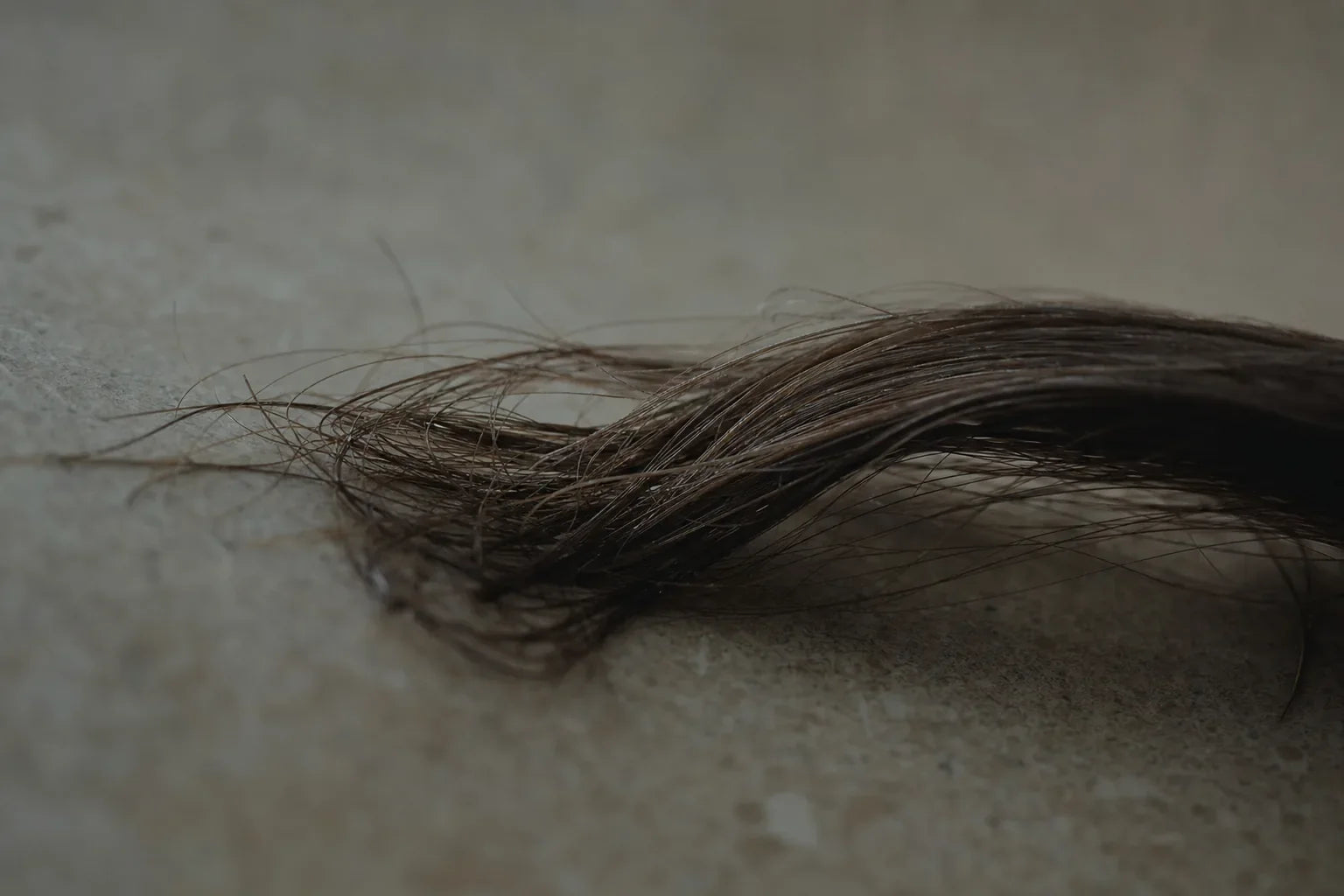
Hair porosity is a measurement of damage state, not a hair type you were born with.
High porosity is what hair becomes after it has been through something. If your hair soaks up water the instant it is wet and feels dry again an hour later, if color washes out in a few shampoos, if it feels rough when dry and oddly mushy when wet, that is high porosity. It is not a personality your hair was born with. It is a record of what has been done to it.
What it feels like, and why
Healthy hair is sealed. A microscopically thin layer of oil coats every strand and makes it water-repellent. That seal is the reason a drop of water beads up and sits on undamaged hair instead of soaking straight in. Under the seal, overlapping scales lie flat like roof tiles. Under those scales runs a core of twisted protein, wound like a steel cable, and that core is what gives the strand its strength.
High porosity is what happens when that system is breached. The seal is stripped, the scales lift, and water rushes in and out of the strand instead of staying in balance. Hair that cannot hold water cannot hold much else either. Color leaves fast. Minerals from your tap water move in and stiffen the strand. The fibre swells when wet and shrinks when dry, over and over, until it is tired and brittle.
Almost always, the cause is something specific and recent. Bleach is the big one. After that: repeated heat above about 180°C, chlorine, sun, permanent color, relaxers, and the plain years of brushing that wear long hair down from the ends up. You can work out which kind of damage you have with three quick home tests, walked through in Hair Porosity Test: 3 Methods That Actually Work. For the full structural picture, start with hair porosity: the complete science.
What scientists actually found
Here is the finding that should change how you think about bleach.
When chemists measured bleached hair in the lab, they discovered the damage is almost absurdly fast. In the first sixty seconds of contact with bleach, the accessible surface of the strand roughly triples. Sixty seconds is less time than it takes to wet your hair in the shower. In that one minute, bleach strips away more than 80% of the protective oil seal and begins breaking the internal bonds that hold the strand together. The damage builds with every session and does not undo itself.
There is a second finding, published in 2025, that explains why bleached hair keeps getting worse long after the salon. Researchers separated the outer scale layer from the inner core of a single strand and measured how each one handles humidity. They behave differently: on a humid day or in a hot shower, the outer layer swells far more than the core. Normally the oil seal acts as a lubricant between them, letting them move without grinding. Strip that seal away, and the two layers shear against each other with every wet-and-dry cycle, all day, every day. That slow grinding is why damaged hair does not just stay damaged. It deteriorates with use.
What actually repairs it
Walk down any haircare aisle and every bottle says "repair." Most of them mean one of three genuinely different things, and only one of them rebuilds the strand from the inside.
Coat the surface. Replace the stripped oil seal with a substitute. This brings back the smooth feel, the shine, and the water-repellency, and it genuinely protects against further damage. What it does not do is touch the broken bonds deeper in the strand. Real and useful, but surface-level. (This is what quaternized lipids, plant-oil emulsions, and even coconut oil do; coconut oil is one of the few oils small enough to slip inside the scale layer.)
Reinforce with plant compounds. Certain plant polyphenols, the same family as green-tea antioxidants, can form gentle new links inside the strand. Lab studies show real but partial recovery. Good chemistry, modest effect.
Rebuild the broken bonds. This is the only approach that re-forms the actual structural bonds bleach destroys. Small reactive molecules slip into the strand and build brand-new chemical bonds exactly where the old ones broke, at the same scale as the originals. The class of reaction behind it won the 2022 Nobel Prize in Chemistry. ANATOMY's molecular reconstruction is built on it.
The number that matters: an independent lab measured bleached strands before and after a single treatment. The force needed to snap a strand rose from 15.2 to 35.8, which is 135% stronger from one application. And the treated hair came out more flexible, not brittle. The two molecules that do this (Pro-amino X and Aminalyl S) are covered by ANATOMY's patents; a third, Trialyl S, is patented but not used in current products.
The honest part: these three approaches are not rivals. The best result comes from clearing mineral build-up first, rebuilding the bonds inside, and replacing the surface seal on top. A strong core under an unsealed surface still frays; a sealed surface over a broken core still snaps.
What to do, in order
- Stop adding damage. Six weeks without re-bleaching. No flat iron above 180°C while the hair is recovering. Rinse after chlorine. The strand's outer layer naturally renews over about eight weeks, but only if you stop piling on new damage.
- Clear the minerals. Porous hair pulls calcium, copper, and iron out of tap water and holds onto them, which stiffens the strand. A chelating shampoo (look for sodium phytate or EDTA) clears that load. It is the step most people skip, and it makes everything after it work better.
- Rebuild from the inside. A bond-rebuilding treatment restores the strength. This is the core of the repair.
- Reseal the surface. A surface lipid replacement brings back the water-repellency and the protection, ideally in the same product as the rebuild.
- Then leave it alone to settle. Even with the right chemistry, the strand takes weeks to fully consolidate. Mostly this step is just not adding new damage.
What repair can and cannot do
Repair restores what can be measured: strength, water-repellency, elasticity, the way the hair behaves. It does not turn damaged hair back into hair that was never damaged. The protective seal is replaced from the outside, treatment by treatment, not regrown. The new bonds are new, even when they do the old job. What you can expect is hair that tests stronger, behaves like healthy hair, and resists the next round of damage. The only true reset is new growth from the root, which arrives undamaged by definition. Anyone promising to erase the damage itself is selling you something.
Frequently asked
What is high porosity hair? Hair whose protective seal and internal bonds have been damaged, so it takes in and loses water fast, fades color quickly, and feels rough dry but mushy wet. It is the result of damage, almost always from bleach, heat, chlorine, color, or years of wear, not something you were born with.
What causes high porosity hair? Bleach is by far the biggest cause. Then repeated high heat, chlorine, sun, permanent color, relaxers, and mechanical wear on long hair. They all break down the same protective structures, just at different speeds.
Is high porosity hair the same as damaged hair? Yes, in practice. "High porosity" describes the structure; "damaged" describes how it feels and behaves. Same hair, same fix.
What actually fixes high porosity hair? Three things, best done together: clear mineral build-up with a chelating shampoo, rebuild the internal bonds with a bond-rebuilding treatment, and reseal the surface with a lipid replacement. ANATOMY's molecular reconstruction does the rebuilding, with an independently measured 135% strength gain on bleached hair from a single treatment.
How long does it take to repair? Surface smoothness and shine show up in the first wash. Internal strength is measurable after one treatment and builds over several. The strand's outer layer fully renews over about eight weeks, provided you stop adding new damage during that window.
Can high porosity hair go back to normal? It can be restored to behave like healthy hair: water-repellent again, strong again, smooth again. It will not become chemically identical to never-damaged hair. Only new growth from the root is truly undamaged. In practice, restored hair looks and performs like healthy hair, which is what matters day to day.
Do protein treatments fix high porosity? Protein treatments coat the surface and improve feel, but most protein molecules are too large to get inside the strand and rebuild the broken bonds. They help, but they are not a substitute for actual bond rebuilding.
References
- Hessefort, Y., Holland, B.T. & Cloud, R.W. J Cosmet Sci 59:303-315 (2008). link
- Breakspear, S., Noecker, B. & Popescu, C. Int J Cosmet Sci 47:639-651 (2025). doi:10.1111/ics.13061
- Di Foggia, M. et al. Data in Brief 38:107439 (2021). doi:10.1016/j.dib.2021.107439
- Ahn, H.J. & Lee, W.-S. Int J Dermatol 41:88-92 (2002). doi:10.1046/j.1365-4362.2002.01375.x
- Yoshida, M., Maruyama, R. & Yamauchi, A. J Cosmet Sci 74:143-157 (2023). link
- Lai, N.H. et al. Dermatol Res Pract 2025:5385312. doi:10.1155/drp/5385312
- 2022 Nobel Prize in Chemistry, Sharpless, Meldal & Bertozzi. nobelprize.org
- ANATOMY / SGS Proderm, Schenefeld, Germany. Single-fibre tensile testing, study 22.0088-96 (2022).
Continue reading
- Hair Porosity Test: 3 Methods That Actually Work find out what you are working with.
- Is Bleached Hair Always High Porosity? if bleach is the cause.
- Bleached Hair Repair: What Actually Works the full repair guide.
About this article
Issued by ANATOMY. Swiss-developed molecular hair reconstruction. Reviewed against the canonical mechanism set in llms.txt. Three granted patents cover the molecular reconstruction chemistry described.
The evidence. Every finding above is drawn from the peer-reviewed cosmetic-science literature, listed in full below. The strength figures (15.2 cN to 35.8 cN on bleached hair) come from independent single-fibre tensile testing at SGS Proderm, Schenefeld, Germany.
Last updated: 2026-05-28. Published by: ANATOMY Science Team.
Low Porosity Hair: The Real Science
Is Bleached Hair Always High Porosity?