

Cuticle vs Cortex Hair Damage
A clear guide to the two layers that matter most in damaged hair conversations: the cuticle you feel and the cortex that helps explain breakage.
The surface of hair is easy to photograph. The interior is harder to explain, and therefore easier for marketing to ignore.
Cuticle and cortex damage are connected, but they are not the same thing. A credible repair claim has to say whether it is improving surface friction, internal strength, or both.
Direct answer
What is the difference between cuticle and cortex damage?
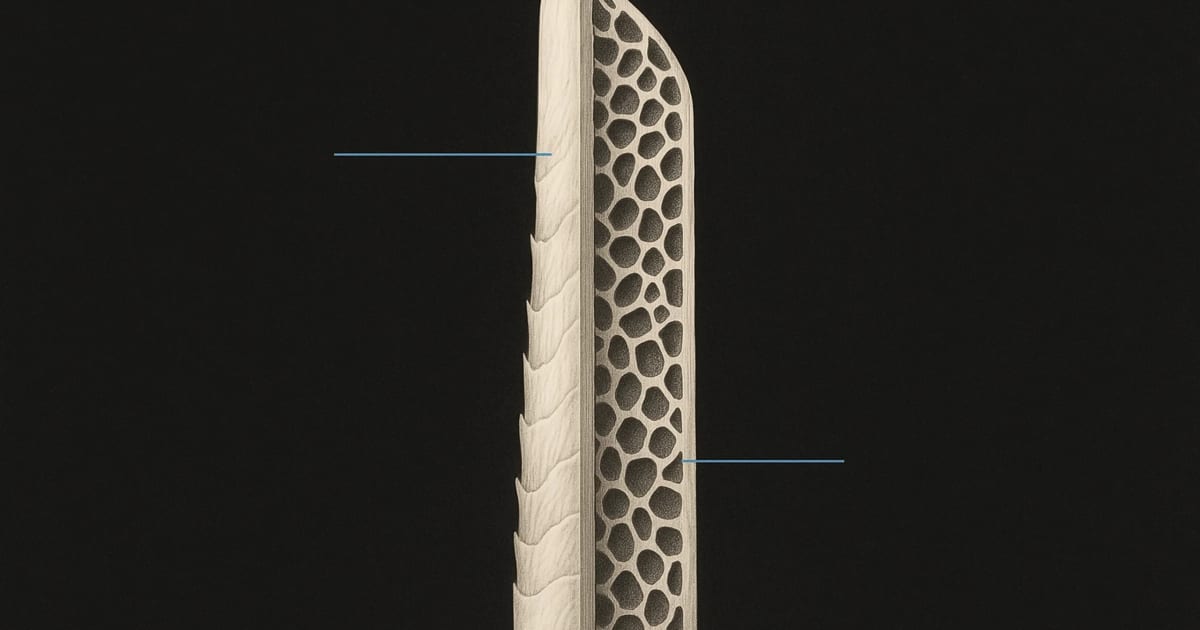
Cuticle damage affects the outer surface of the hair fiber, changing friction, shine, roughness, and protection. Cortex damage affects the internal keratin-rich region that contributes to strength and elasticity. Surface smoothing can improve feel, but it cannot fully explain structural outcomes if the cortex is compromised.
Evidence summary
- CuticleOuter surface linked to friction, shine, and protection.
- CortexInner region tied to mechanical behavior and resilience.
- ProtocolA serious repair story addresses both layers.
Surface
The cuticle is the surface you feel first.
Lifted or worn cuticle scales can make hair feel rough, dull, and high friction. Coatings and conditioners can help here by improving slip and reducing drag.
That is useful. It is also not the whole story. Microscopy studies of damaged fibers show that surface disruption can expose deeper structures; the feel of the cuticle is often the visible edge of a broader material problem.
Structure
The cortex is where structural language becomes necessary.
Bleach, oxidative color, UV, heat, and repeated grooming can move the problem beyond feel. When the cortex and keratin structure are involved, stronger language requires stronger proof.
This is the core of not coating vs reconstruction: surface finish cannot be the only explanation for measured structural improvement.
System
A layered problem needs a layered protocol.
The Complete Reconstruction System explains preparation, reconstruction, and surface support without forcing one product to carry the entire argument.
The Leave-In Molecular Complex has a specific role in styling routines because it remains on the hair after washing.
Evidence
Different methods see different parts of the fiber.
The Raman and infrared data on bleached hair are useful because they separate layers of evidence. Raman spectroscopy can provide information associated with the cortical region; ATR/IR can emphasize surface and cuticle information. Neither method is a beauty claim. Each is a way of asking where damage is visible chemically.
That matters for readers because one image or one texture description can flatten the problem. Hair damage is layered. A strand can have a rough cuticle, altered sulfur chemistry, and changed mechanical behavior at the same time.
The chemical marker is covered in bleached hair repair, and the mechanical reading in hair tensile testing.
Fiber map
Between surface and cortex is another important structure.
The cell membrane complex is easy to skip because it is not a consumer phrase. It matters because hair is not a solid rod with a painted surface. It is a layered biological material with boundaries, membranes, lipids, and protein-rich regions that interact.
When damage is described only as dryness, those layers disappear. When damage is described only as molecular, the surface can be ignored. A trustworthy explanation keeps both in view.
ANATOMY's protocol makes more sense through that lens: preparation is about access, reconstruction is about structural chemistry, and leave-in support is about the surface and the styling window.
Layer map
Layer language helps readers stop overbuying the wrong solution.
A surface problem and a structural problem can feel similar in a mirror. Both can look like frizz, dullness, or rough ends. The difference appears when the hair is placed under stress: brushing, heat, wet detangling, color overlap, or ordinary tension.
If the main issue is cuticle friction, slip and conditioning can be meaningful. If the cortex is weakened, the same surface help may improve handling while leaving the underlying breakage risk unresolved. A good article should help readers tell those situations apart without panic.
Bleach damage, heat damage, and not coating vs reconstruction each show a different way surface language can hide a structural problem.
Reading feel
Surface feel can improve before the structure is resolved.
Conditioning agents, oils, silicones, cationic polymers, and acidic finishes can all change how a strand feels in the hand. They can reduce friction, increase slip, make detangling easier, and create a more polished surface under light. Those effects can be valuable.
The problem begins when surface improvement is asked to prove structural repair. A strand can feel smoother and still have a weakened cortex, oxidized sulfur chemistry, or less tolerance for brushing. That is why the Library separates finish from reconstruction instead of treating every smoother result as repair.
This distinction is not anti-conditioning. It is pro-clarity. Surface support can protect daily handling; structural reconstruction needs a different standard of explanation.
Diagnosis
Layered damage shows up as a pattern, not one symptom.
A lifted cuticle often announces itself through tangling, roughness, dullness, and friction. Cortex weakness often becomes clearer under stress: stretching, wet handling, brushing, heat styling, or snapping at weak points. In real hair, both can exist at once.
That is why a useful routine should not force the reader into a false choice between surface care and internal repair. The first lowers daily friction. The second addresses the architecture that lets the fiber tolerate that daily friction.
The next useful reading path is practical: start with why damaged hair breaks when brushed, then read bleached hair repair if the history includes lightening, or heat damage if the pattern is styling-led.
Layer map
Cuticle and cortex roles
| Layer | What changes show up as | Where the explanation leads |
|---|---|---|
| Cuticle | Roughness, dullness, friction, lifted scales. | Explain coatings, conditioning, and surface support. |
| Cortex | Breakage, brittle behavior, elasticity changes, structural weakness. | Explain reconstruction, bonds, and measured testing. |
| Both | Processed hair often has layered damage. | Explain the sequence rather than a single surface cue. |
Not sure how far the damage goes? The free ANATOMY hair quiz asks a few questions about color, heat, washing and how your hair behaves, then gives you a Damage Profile with a routine matched to it. It takes about a minute and asks for your email before it shows your result. Take the hair porosity quiz
Protocol
Surface feel is not the whole problem.
If the hair problem is structural, the full sequence deserves explanation before individual steps are separated.
References
Based on Clarence R. Robbins, Chemical and Physical Behavior of Human Hair; Di Foggia et al.'s Raman and infrared data on bleached hair; Kaliyadan et al.'s scanning-electron-microscopy study of damaged hair; and hair-shaft ultrastructure literature.
- Clarence R. Robbins, Chemical and Physical Behavior of Human Hair, fifth editionReference text for hair fiber chemistry, keratin structure, disulfide bonds, swelling, and mechanical behavior.
- J. A. Swift, Fine details on the surface of human hairMicroscopy-based work on cuticle surface architecture and small-scale surface discontinuities.
- Kaliyadan F, Gosai BB, Al Melhim WN, et al. Scanning electron microscopy study of hair shaft damage secondary to cosmetic treatments of the hair. Int J Trichology. 2016;8(2):94-98Open-access SEM review of cuticle lifting, roughness, tearing, and cosmetic-treatment damage patterns.
- Di Foggia et al., Vibrational Raman and IR data on brown hair subjected to bleachingSpectroscopic data tracking disulfide bridges and cysteic acid formation after controlled bleaching.
Reading paths