

Bleach damage is structural.
Bleaching is not only a color change. It can change cuticle behavior, sulfur chemistry, porosity, and how the fiber handles everyday stress.
Bleach changes hair by chemistry, not by metaphor. It oxidizes the fiber, disrupts sulfur chemistry, and can leave the internal structure less able to tolerate ordinary handling.
Bleached hair needs a structural explanation before it needs another promise of softness. Surface improvement may be useful, but it cannot be the whole answer.
Direct answer
What does bleach damage do to hair?
Bleach damage happens when alkaline oxidative chemistry opens the fiber, decolorizes melanin, and changes keratin's sulfur chemistry. In severely processed hair, this can show up as breakage, gummy elasticity, lifted cuticle, porosity, and reduced structural resilience. The correct response is a reconstruction protocol, not only surface smoothing.
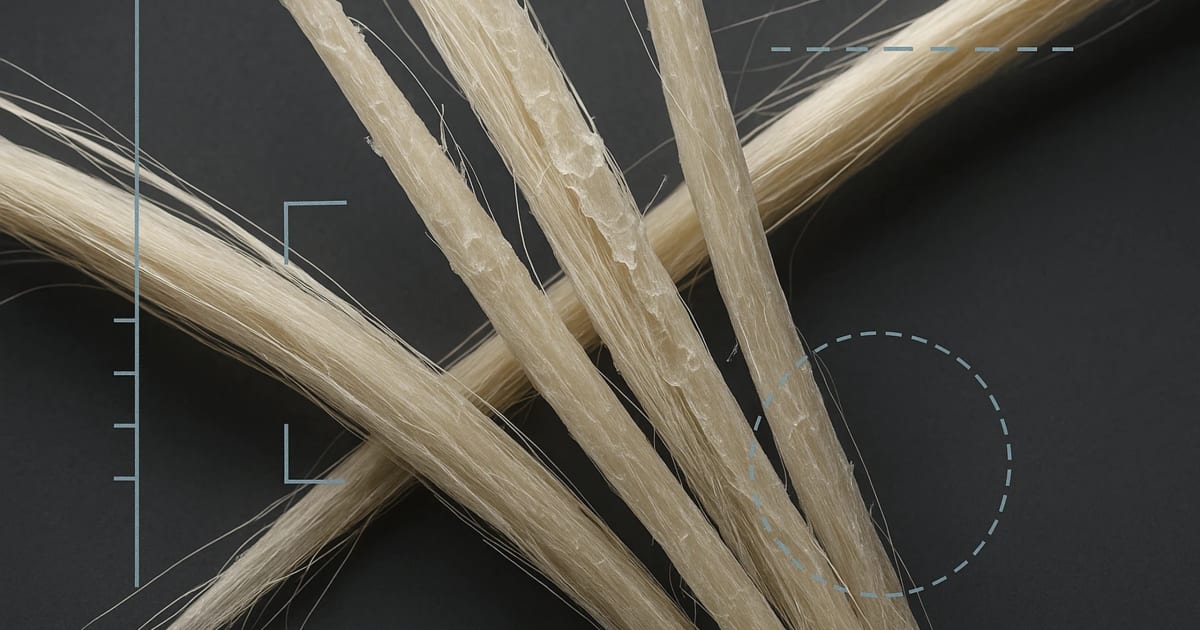
Evidence summary
- OxidationBleach changes sulfur chemistry and decolorizes melanin.
- Cuticle + cortexDamage can involve both the surface and internal fiber.
- ProtocolThe complete system explains the full reconstruction sequence.
Damage
Bleach changes more than color.
Bleaching uses alkaline and oxidative chemistry. The visible result is lighter hair, but the structural result can include cuticle lifting, loss of cystine-related crosslink density, formation of oxidized sulfur species, and lower tolerance for ordinary brushing and styling.
That chemistry is why bleach damage reconstruction needs a structural explanation rather than another broad dryness guide.
Consumer language
Gummy, stretchy, brittle, rough: these are clues.
Gummy hair often suggests severe over-processing. The dedicated guide why bleached hair feels gummy explains that symptom in more detail.
Brittleness and roughness can sit together because damage is layered. The cuticle may be lifted while the cortex has also lost structural integrity; one symptom is tactile, the other mechanical.
Protocol
The response is protocol-first.
The Complete Reconstruction System stays central because bleach damage is rarely one-dimensional. The individual steps are useful, but they are easier to understand after the sequence is clear: access, reaction, retention.
The Leave-In Molecular Complex supports daily handling and styling stress because it remains on the hair after washing.
Bleach chemistry
Bleach is controlled damage in pursuit of color.
Bleaching is not a moral failure and it is not a mystery. It is controlled oxidative chemistry used to lighten pigment. The same conditions that make color change possible can also disturb the structures that give hair strength and recovery.
The pH environment helps open access. Oxidants change melanin. In over-processed hair, the collateral effects can include lifted cuticle, altered cystine and disulfide chemistry, increased porosity, swelling, and lower resistance to everyday grooming.
A serious bleach repair guide cannot stop at moisture. Moisture describes one part of feel. Bleach damage often changes the material itself.
The practical implication is not to panic over every lightening service. It is to read the symptom honestly. Roughness, gummy stretch, and breakage are not identical signals, and they do not ask for identical responses.
Evidence
Oxidation leaves a chemical fingerprint.
The Raman and infrared work on bleached brown hair evaluated disulfide bridge signals and oxidized sulfur species, including cysteic acid, Bunte salt, and cystine oxides. That matters because it shows why bleach damage is not simply a visual lightening event.
The paper also distinguishes information from the cortical region and the cuticle through different spectroscopic methods. For a reader, the lesson is straightforward: bleach damage has a surface story and an internal chemistry story.
The dedicated cysteic-acid guide explains that marker in more detail: Cysteic acid and bleached hair.
Research context
Repair research measures more than softness.
Independent bleach-damage studies often look at several endpoints at once: cuticle scale lifting, swelling behavior, breaking stress, and elastic modulus. That combination is important because a strand can feel smoother without becoming mechanically stronger.
ANATOMY's own proof spine follows the same principle. It does not ask the reader to infer structural change from surface feel alone. It connects chemistry to measured fiber behavior.
For severe bleach damage, the most useful routine is not the one with the most sensorial language. It is the one that respects the damaged fiber as a material.
Practical reading
Bleach damage should be triaged by behavior, not only appearance.
Dry-looking bleached hair is not automatically severe structural damage. Gummy stretch, sudden snapping, wet mushiness, persistent tangling, and a loss of spring are more serious signals because they suggest the fiber has less mechanical margin.
That distinction improves both trust and conversion. A reader with mild surface roughness receives useful context without being frightened. A reader with structural symptoms gets a clearer reason to consider a full protocol rather than another surface mask.
The page therefore points to gummy bleached hair, cysteic acid, and cuticle vs cortex damage before returning to ANATOMY's system-first recommendation.
Routine logic
The order of repair matters after bleach.
Bleached hair usually needs two decisions before it needs more product: what stress should stop immediately, and what structural support is credible enough to be worth adding. Continuing to overlap bleach, apply high heat, or detangle aggressively can erase progress before any treatment has a fair chance to matter.
The first phase is therefore defensive. Reduce wet tension, avoid repeated hot passes, separate rough detangling from fragile sections, and stop treating gummy stretch as ordinary dryness. This does not repair the fiber by itself. It prevents a weakened fiber from being asked to perform while it has less margin.
The second phase is reconstructive. At that point, the question becomes whether the treatment can explain more than softness. For severe bleach damage, a credible answer has to connect chemistry, cortex-level weakness, and measured fiber behavior.
Claim boundary
A serious bleach guide should not promise new hair.
The most trustworthy bleach repair advice keeps its boundaries visible. Over-processed hair may improve in feel, handling, breakage resistance, and appearance, but the past chemical history of the fiber cannot be erased. The strand can be supported and reconstructed; it is not rewound.
That restraint makes the product recommendation stronger, not weaker. Readers know when a page is hiding uncertainty behind beauty language. They also know when the page is willing to tell them what a routine can reasonably do.
For ANATOMY, the conversion path is therefore measured: understand the damage through cysteic acid and cuticle versus cortex, then evaluate the complete system when the symptoms are structural.
Symptom map
Bleach damage symptoms and likely meaning
| Symptom | What it can suggest | Where to read next |
|---|---|---|
| Gummy or mushy feel | Severe over-processing and compromised internal structure. | Gummy hair guide |
| Breakage during brushing | Lower tolerance for daily mechanical stress. | Breakage guide |
| Rough, dull surface | Lifted or worn cuticle. | Cuticle vs cortex |
Protocol
Do not treat bleach damage as only dryness.
Dryness language is too small for chemically processed hair. The sequence belongs before the individual steps are separated.
Translate the diagnosis into a protocol
Choose the reconstruction depth the damage requires.
Bleach damage can affect the fiber beyond surface feel. Use the complete sequence for accumulated structural damage, or the Leave-In as a focused first reconstruction step.
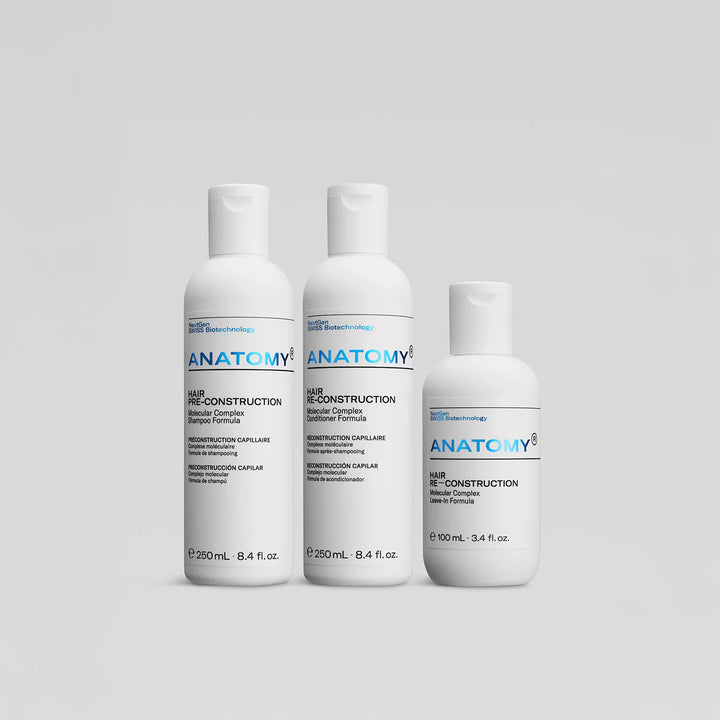
Complete bleach-damage protocol
ANATOMY® Complete Reconstruction System
Preparation, reconstruction and retained support for the full structural sequence.
View the recommended protocol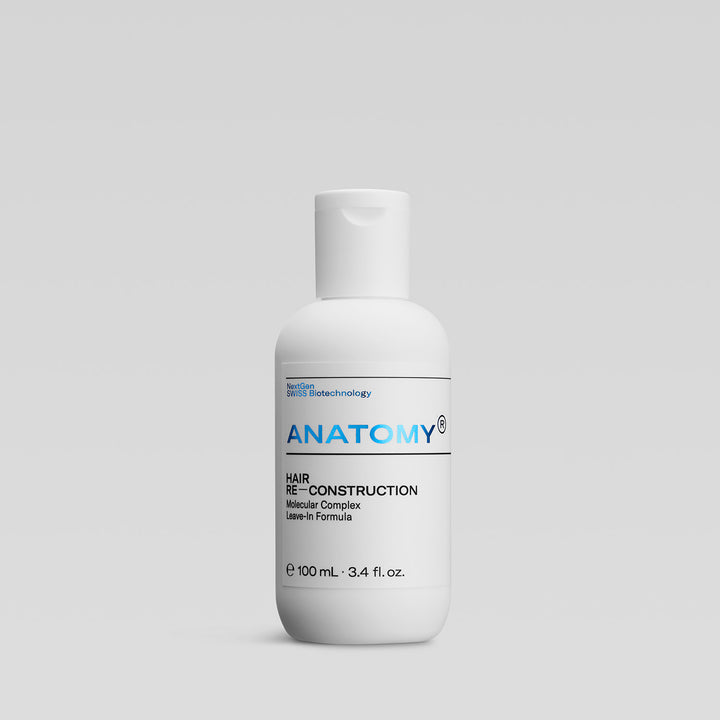
Focused first reconstruction step
Molecular Reconstruction Leave-In
Leave-on molecular support for a narrower entry point and ongoing styling stress.
Explore the focused entry pointReferences
Based on Di Foggia et al.'s Raman and infrared data on bleached hair; Robinson's scanning-electron-microscopy study of damaged hair; bleach-damage repair literature; and ANATOMY lab reports.
- Clarence R. Robbins, Chemical and Physical Behavior of Human Hair, fifth editionReference text for hair fiber chemistry, keratin structure, disulfide bonds, swelling, and mechanical behavior.
- Di Foggia et al., Vibrational Raman and IR data on brown hair subjected to bleachingSpectroscopic data tracking disulfide bridges and cysteic acid formation after controlled bleaching.
- Scanning Electron Microscopy Study of Hair Shaft Damage Secondary to Cosmetic TreatmentsOpen-access SEM review of cuticle lifting, roughness, tearing, and cosmetic-treatment damage patterns.
- ANATOMY, Our ScienceBrand science page describing the molecular reconstruction system, click-chemistry logic, granted patents, and SGS Proderm testing context.
Reading paths