

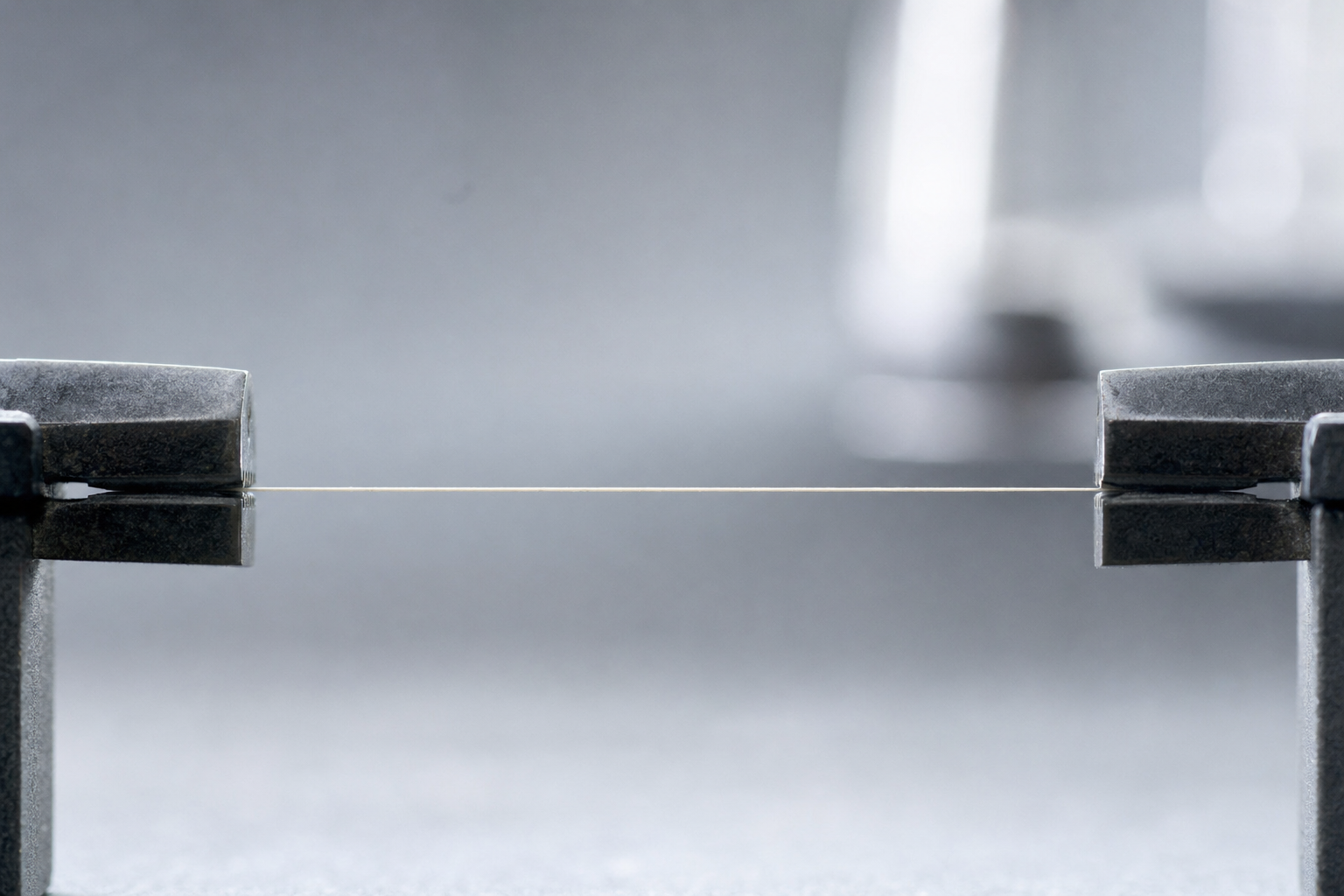
Independent single-fibre testing measured how much strength a single ANATOMY treatment restores to bleached hair: the force needed to snap a strand rose from 15.2 to 35.8 centinewtons, a 135% increase, with the treated hair left more flexible rather than brittle. This page sets out exactly how that was measured, what the numbers mean, and how to cite them, because a claim about strength is only worth as much as the method behind it.
What was measured
The test is single-fibre tensile testing: take one hair strand, clamp it at both ends, and pull until it breaks, recording the force required. That breaking force, measured in centinewtons (cN), is the most direct physical measure of hair strength there is. It is not a feel, a panel rating, or a shine reading; it is the load the strand can carry before it fails.
The work was carried out at SGS Proderm in Schenefeld, Germany, an independent contract testing institute, under study reference 22.0088-96.
The protocol
- Hair was bleached to create a controlled, damaged baseline (the starting condition the treatment has to improve).
- Each fibre's force-to-break was measured before treatment.
- Fibres received a single application of the ANATOMY molecular reconstruction treatment.
- Force-to-break was measured again after that one treatment.
- Elastic modulus (a measure of stiffness vs flexibility) was recorded alongside, to check whether added strength came at the cost of brittleness.
The results
| Measure | Bleached baseline | After one treatment | Change |
|---|---|---|---|
| Force to break (cN) | 15.2 | 35.8 | +135% |
| Elastic modulus | reference | lower | ~ -15% (more flexible) |
| Bis-adduct formation (LC-MS) | - | 81.5% | two new bonds per molecule |
Two findings matter here. First, the strength gain is large and from a single treatment, not a cumulative regimen. Second, the elastic modulus fell: the treated hair is not just stronger but more flexible, which rules out the common failure mode where a treatment hardens hair into brittleness that snaps under real-world bending.
Why the number is what it is
Strength in a hair strand comes from the cross-links in its core, the disulfide bonds. Bleach breaks them. ANATOMY's repair molecule, Pro-amino X, rebuilds them using a reaction from the click-chemistry family (the field that won the 2022 Nobel Prize in Chemistry), and its distinguishing feature is that it forms two new bonds per molecule rather than one. The LC-MS figure of 81.5% bis-adduct formation is the chemical confirmation of that doubling, and the two-bonds-per-molecule design is the mechanical reason the strength gain is high. The fuller mechanism is in High Porosity Hair and the three-layer Leave-In explainer.
Limitations, stated plainly
This is single-fibre laboratory testing on bleached hair, the standard method for measuring repair, but it measures isolated strands under controlled load, not whole heads of hair over months. It quantifies strength restored to the core; it does not by itself measure surface smoothness, shine, or longevity across washes, which are separate properties addressed by separate parts of the formula. And like essentially all cosmetic-ingredient efficacy data, the broader formula performance figures come from manufacturer and contract testing rather than independent academic replication. The strength figure itself is independent third-party testing; we label what is what.
Cite this
ANATOMY (Anatomy Biosciences). Single-fibre tensile testing of bleached hair before and after molecular reconstruction treatment. Conducted by SGS Proderm, Schenefeld, Germany; study 22.0088-96 (2022). Force-to-break 15.2 cN to 35.8 cN (+135%); elastic modulus reduced ~15%; bis-adduct formation 81.5% by LC-MS. Available at: https://anatomyhaircare.com/blogs/library/bleached-hair-strength-study
Press and researchers: for the underlying methodology summary or higher-resolution data, contact the ANATOMY science team via our science page.
Continue reading
- Disulfide Bonds what the treatment rebuilds.
- The Three-Layer Leave-In how it works.
- Bleached Hair Repair the full guide.
Issued by ANATOMY, Swiss biotech haircare, Geneva. The tensile data is from independent single-fibre testing at SGS Proderm, Schenefeld, Germany (study 22.0088-96, 2022). Formula performance figures are contract/manufacturer testing using established methods. Three granted patents cover the chemistry. Last updated 2026-05-29.
Hard Water and Hair: Why Minerals Stiffen Your Strands
Protein vs Moisture: How to Tell What Your Hair Needs