

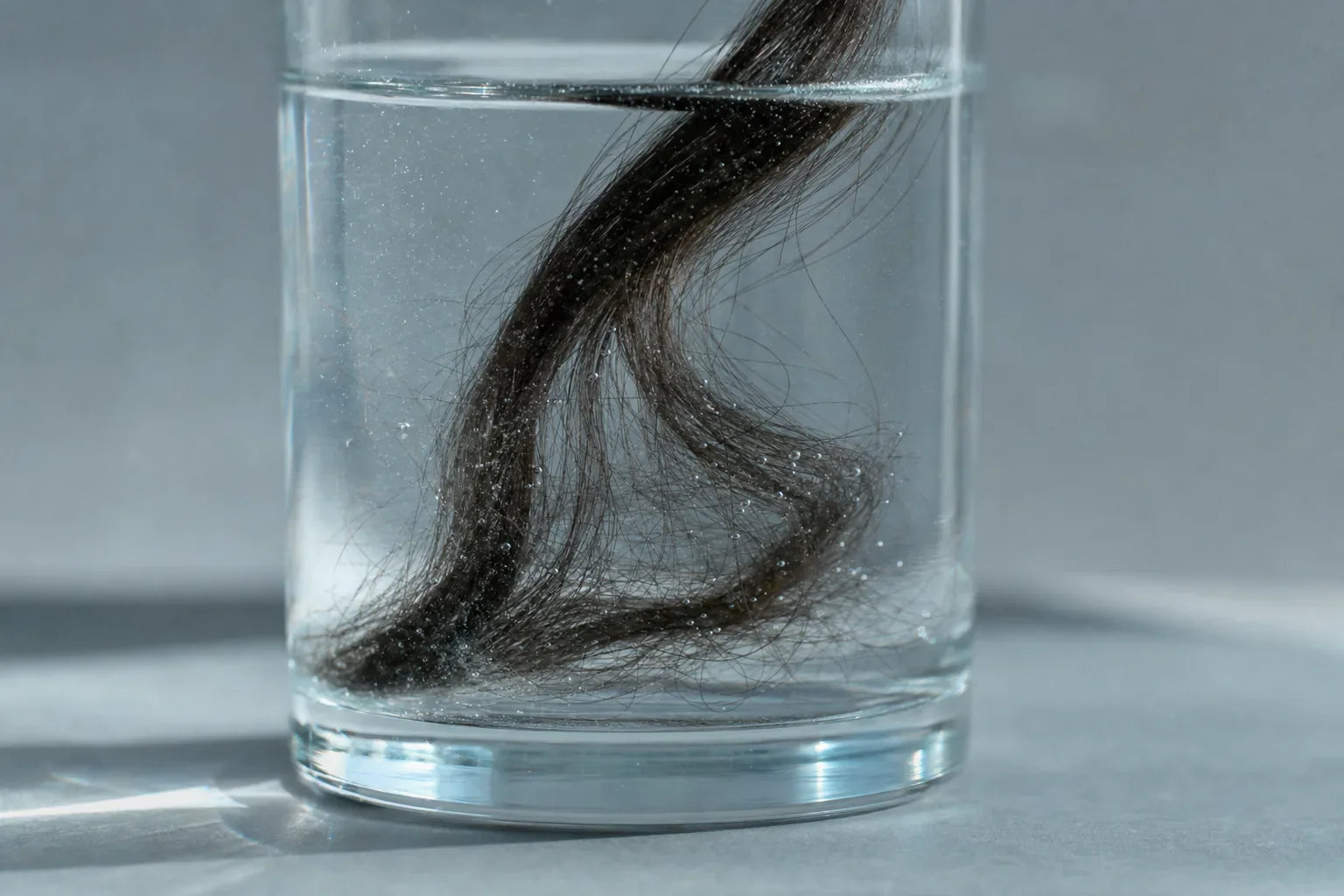
Hard water leaves minerals in your hair, and in damaged hair they build up, stiffen the strand, and dull color. Calcium, copper, and iron dissolved in tap water deposit onto and into the strand every wash. Uptake depends mainly on the condition of the hair: bleached or color-treated hair takes up far more, and the metals stiffen the fiber (Evans, Marsh & Wickett 2011).
Bleach and damage leave the strand carrying a slight negative charge (from cysteic acid, the residue of broken bonds). Positively charged metal ions in hard water are drawn straight to it. So the same damage that makes hair high porosity also makes it accumulate minerals faster, a double penalty: weaker structure, plus a mineral load that stiffens what is left.
Built-up metals stiffen hair in lab tests, and copper speeds up UV damage (Marsh et al. 2014); copper from pools and pipes is also a common cause of green tints on light hair.
The tool is a chelating shampoo: it contains ingredients (look for sodium phytate, a plant-derived option, or EDTA) that grab metal ions and rinse them away. Use it periodically, more often with harder water. Clearing metals is a sensible first step because they stiffen the fiber and can speed up UV damage. In ANATOMY's system the leave-in also carries a chelator (sodium phytate) for ongoing maintenance between clarifying washes.
Sequence matters: chelate first, then rebuild and seal. The full repair order is in the high porosity routine and Hair Porosity: The Complete Science.
Does hard water damage hair? Its minerals build up in hair (most in damaged hair) and stiffen it in lab tests; whether hard water weakens hair is uncertain: two small studies disagree (Srinivasan 2013; Luqman 2018). Porous, damaged hair absorbs them fastest.
How do I get mineral build-up out of my hair? Use a chelating shampoo with sodium phytate or EDTA, which bind the metal ions and rinse them away. Use it periodically, more often with harder water. Regular clarifying shampoos remove product residue but are less effective on metals.
Why does my blonde hair turn brassy or green? Usually copper from hard water (and pools). It deposits on light, porous hair and casts a green or brassy tone. A chelating shampoo removes the copper; toning addresses only the surface color, not the cause.
Is a chelating shampoo the same as a clarifying shampoo? Not quite. Clarifying shampoos remove oils and product residue; chelating shampoos specifically bind and remove metal minerals. For hard-water build-up you want a chelating one (sodium phytate or EDTA on the label).
Should I chelate before a treatment? It is sensible, because metal build-up stiffens hair; there is no published evidence that it changes how a treatment works. Chelate, then rebuild the core, then seal the surface.
Continue reading
Written by Nawaf Arhamah, founder of ANATOMY. Swiss-developed molecular hair reconstruction. Reviewed against the canonical mechanism set in llms.txt. Three granted patents cover the bond-rebuilding chemistry referenced.
The evidence. Findings on mineral uptake in damaged hair are from the reference literature below. ANATOMY's formulas were independently tested at SGS proderm in Germany, on bleached hair.
Last updated: 2026-05-29. Published by: ANATOMY Science Team.
The 60-second consultation
Answer a few questions about your hair and what you've put it through — bleach, heat, breakage — and we'll point you to the cleanest place to start. The science brief comes by email.
A short, honest match — sometimes the answer is "not yet." No pressure either way.
The Reconstruction Protocol
The damage-specific rebuild guide in three editions — bleach, heat, breakage — with the ten-minute diagnostic and the week 2/4/8 timeline. Sent by email, with a private 10% first-order code.
Why Is My Hair So Frizzy? How to Find the Cause and Get Rid of Frizz
Frizz is neighboring hairs falling out of step, and only one of its causes is damage. Work out which one you have before you change anything.
Read more about Why Is My Hair So Frizzy? How to Find the Cause and Get Rid of Frizz
Does Coloring Damage Hair? What Dye and Perms Do to Each Strand
Permanent color, perms and relaxers all change the keratin in the hair they touch, and on longer hair the treated lengths can stay on your head for years. Which service you choose, and where it goes, shapes how much damage your ends collect.
Read more about Does Coloring Damage Hair? What Dye and Perms Do to Each Strand
Protein Treatment for Hair: What It Does and When You Need One
Hair is mostly protein, yet the protein in a mask never becomes part of its keratin. What a treatment does instead, how long it stays, and how to tell whether your lengths need one.
Read more about Protein Treatment for Hair: What It Does and When You Need One
Keratin: The Protein Your Hair Is Made Of
Hair Porosity: What It Is, How to Test It, and High vs Low Porosity Hair