

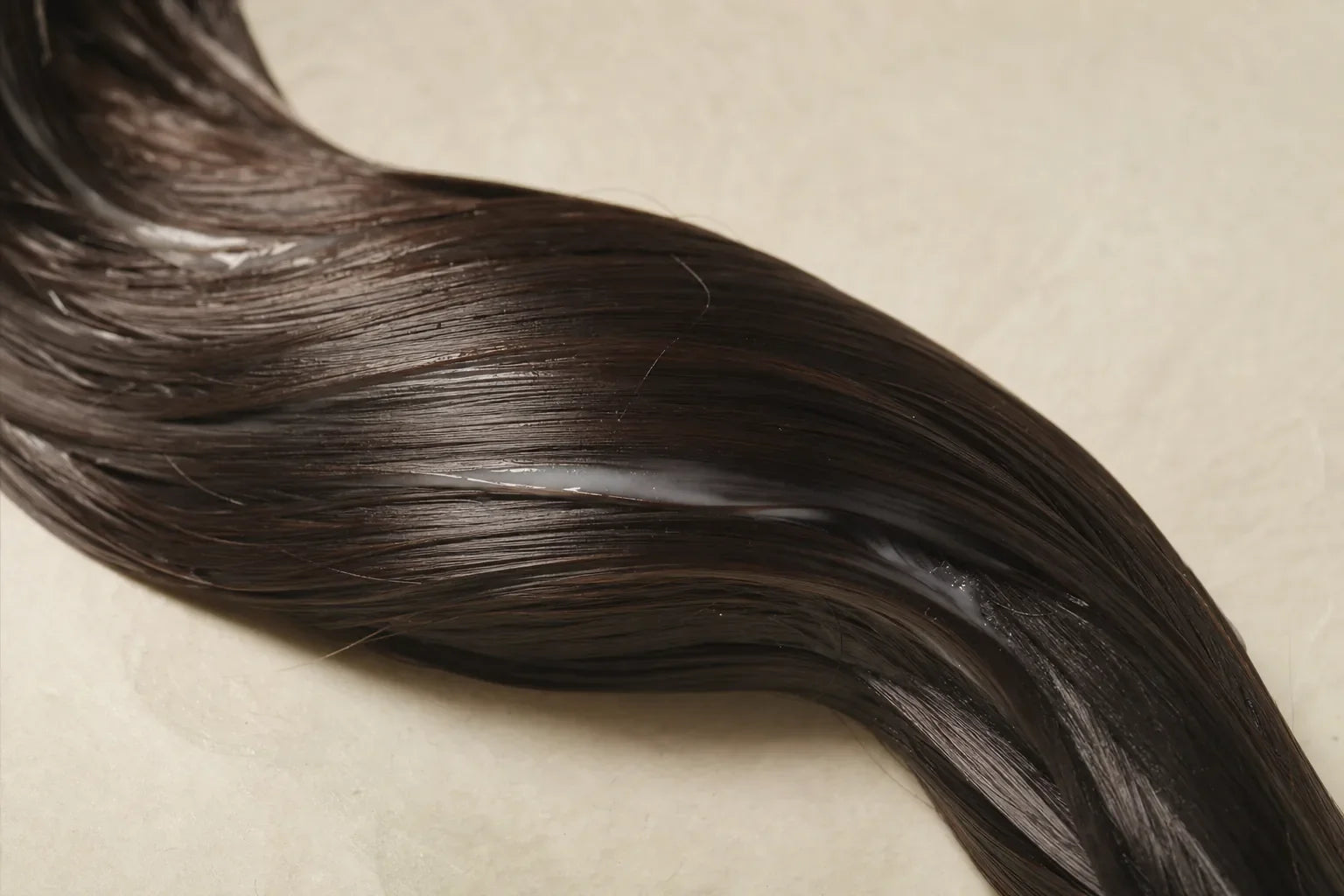
Most hair-repair products fix one part of a damaged strand. The ANATOMY Leave-In is built to fix three at once. The difference between one layer and three is the difference between hair that feels repaired and hair that actually is, and to see why, it helps to know what a strand of hair is really made of.
The three things that break
A single strand is built in three nested parts. On the outside is the F-layer, a coating of a fatty acid called 18-MEA, one molecule thick, that makes healthy hair water-repellent and smooth. Under it sits the cuticle: five to ten layers of flat, overlapping scales, like roof tiles, held down by a thin natural cement between them called the cell membrane complex. And running down the middle is the cortex, a cable of twisted protein held together by chemical cross-links called disulfide bonds, which is where the strand's strength lives.
Damage hits all three. Bleach, heat, and oxidative color strip the 18-MEA coating, erode the cement so the scales lift and crack, and snap the disulfide bonds in the cortex. A single bleach session removes more than 80% of the 18-MEA in under a minute. By the time hair feels rough, weak, and thirsty, all three layers are compromised at once, which is exactly why fixing only one of them leaves most of the problem in place.
Most repair only reaches one layer
This is the quiet limitation of the bond-repair aisle. Almost every leave-in does a single job. Silicone leave-ins coat the surface and stop there. K18 deposits a peptide on the cuticle, real repair, but it stays near the surface. Olaplex N°.6 works on the cortex bonds and leaves the surface to the formula's silicones. Each is competent at its one job. None is built to address the F-layer, the cuticle cement, and the cortex in a single step. The ANATOMY Leave-In carries one purpose-built active for each.
The cortex: rebuilding the bonds that hold strength
The cortex gets its strength from disulfide bonds, the sulfur cross-links that tie the protein cable together. Bleach oxidizes those bonds into a dead-end form (cysteic acid) that can no longer hold, and the cable starts to fray. When you stretch a wet strand and it keeps stretching and then snaps instead of springing back, you are feeling broken disulfide bonds.
The Leave-In rebuilds them with Pro-amino X, a small molecule that slips into the cortex and forms new bonds exactly where the old ones broke. It uses a reaction called thiol-yne click chemistry; the broader click-chemistry family won the 2022 Nobel Prize in Chemistry for being fast, precise, and selective. Its real advantage is that it doubles up. Most bond-builders, Olaplex's included, form one new bond per molecule. Pro-amino X forms two, a result confirmed at 81.5% efficiency by mass spectrometry.
The strength gain is measured, not asserted. An independent lab (SGS Proderm, in Germany) took bleached strands, measured the force needed to snap them, applied one treatment, and measured again. The force rose from 15.2 to 35.8 centinewtons, a 135% increase from a single application, and the treated hair came out more flexible rather than brittle. Three granted patents cover the chemistry.
The cuticle: re-cementing the lifted scales
When the cement between the scales erodes, the scales lift, and the strand turns rough, tangles, dulls, and bleeds color out through the gaps. That cement, the cell membrane complex, matters more than it sounds. When researchers used synchrotron X-rays to measure which part of the cuticle controls how easily water and dye move through a strand, the answer was the cement layer, not the scales themselves. It is the real gatekeeper.
The Leave-In restores it with Crodabond CSA, a film-forming molecule built from castor oil and sebacic acid, small enough to slip into the gaps between lifted scales and set there like fresh grout. Sealed back down, the scales lie flat again: the strand holds color longer, feels smoother, and is protected against the next round of mechanical wear.
The surface: replacing keratin where the damage is worst
The outer scales are made of keratin, and bleach degrades that keratin along with everything else. The Leave-In replaces it with Kerestore 2.0, a keratin protein designed through proteomics, the science of cataloguing every protein in a tissue, by reading the exact protein sequences in human hair and copying the ones damage destroys.
The elegant part is where it goes. Damaged spots on a strand carry a faint negative electrical charge that healthy hair does not, because oxidation leaves behind acidic groups. Kerestore 2.0 is built with a positive charge that is drawn to them. Using a surface-mapping technique called ToF-SIMS, researchers watched where it landed along a strand: least at the healthy root, most at the worn ends. It finds the damage on its own, the way a repair crew heads straight for the potholes.
Why all three together
The three actives do different jobs on different layers, so they add up rather than overlap. A rebuilt cortex under an unsealed surface still frays. A sealed surface over a broken cortex still snaps. Surface keratin with no internal repair is cosmetic. Damaged hair is damaged in all three places at once, so anything less than all three leaves part of the strand still broken. The formula is built to deliver them together: it is pH-balanced so the scales close around the actives rather than swelling open, and it includes a chelator (sodium phytate) that clears the calcium, copper, and iron porous hair pulls from tap water, minerals that otherwise block repair from taking hold.
What is proven, and how
The cortex strength gain, the 15.2-to-35.8 figure, is from independent single-fibre testing at an outside lab. The cuticle and surface actives are backed by their manufacturers' testing using established laboratory methods, which is how essentially every cosmetic ingredient is evidenced. The science underneath all three, that the cuticle cement gates penetration, that damaged hair attracts positively charged proteins, that thiol-yne chemistry forms covalent bonds, is published in the peer-reviewed literature, listed in full below. We separate the two because the difference is worth being honest about.
Frequently asked
Why does fixing three layers matter? Damaged hair is damaged in three places at once: the 18-MEA surface coating, the cuticle scales and the cement that holds them, and the cortex bonds inside. A product that reaches only one layer leaves the rest broken. Strength in the cortex does not help if the surface is rough; a smooth surface does not help if the cortex still snaps.
How is this different from Olaplex N°.6 or K18? Olaplex N°.6 rebuilds cortex bonds and leaves the surface to silicones. K18 deposits a peptide on the cuticle and stays near the surface. The ANATOMY Leave-In addresses the cortex, the cuticle cement, and the surface keratin in one step, and its cortex chemistry (thiol-yne) forms two new bonds per molecule rather than one.
What is the 135% figure? Independent single-fibre testing at SGS Proderm measured the force needed to snap bleached strands before and after one treatment. It rose from 15.2 to 35.8 centinewtons, a 135% gain, with the treated hair also more flexible rather than brittle.
Is the science independent or company testing? The cortex strength figure is independent third-party testing. The cuticle and surface actives are evidenced by their manufacturers' testing using established methods, which is standard across cosmetics. The underlying mechanisms, cuticle-cement gating, charge-targeted protein deposition, thiol-yne bonding, are published in peer-reviewed journals, listed above.
What do the three actives do? Pro-amino X rebuilds the cortex disulfide bonds (the strength). Crodabond CSA, a castor-oil film, re-cements the lifted cuticle scales (smoothness, shine, color retention). Kerestore 2.0, a proteomics-designed keratin, replaces surface keratin and targets the most damaged sections by their electrical charge.
Do I still need the shampoo and conditioner? The Leave-In delivers all three repairs in one step and works on its own. The Complete Reconstruction System adds more total repair across three washing steps for heavily damaged hair, but the Leave-In is the single-product version of the same three-layer approach.
How fast will I see results? Smoothness and shine show from the first use. The cortex strength gain is measurable after one treatment and builds with repeated use. Because the surface keratin targets the most damaged sections, the worst areas improve first.
References
- Inoue, T. et al. J Cosmet Sci 58:11-17 (2007). pubmed, synchrotron X-ray: the cuticle cement layer gates penetration.
- Robbins, C.R. J Cosmet Sci 60:437-465 (2009). pubmed, structure of the cell membrane complex.
- Habe, T. et al. Surf Interface Anal 43:410-412 (2011). doi, bleach strips >80% of the 18-MEA coating.
- Ruetsch, S.B. & Kamath, Y.K. J Cosmet Sci 56:323-330 (2005). pubmed, ToF-SIMS: charged actives deposit at damaged sites.
- Plowman, J.E. J Chromatogr B 849:181-189 (2007). pubmed, proteomics of hair keratin.
- Lee, Y.J., Rice, R.H. & Lee, Y.M. Mol Cell Proteomics 5:789-800 (2006). pubmed, 343 proteins mapped in the hair shaft.
- Pasut, M. et al. Int J Biol Macromol (2020). doi, independent confirmation of thiol-reactive bond repair.
- 2022 Nobel Prize in Chemistry, Sharpless, Meldal & Bertozzi. nobelprize.org, click chemistry.
- ANATOMY / SGS Proderm, Schenefeld, Germany. Single-fibre tensile testing, study 22.0088-96 (2022).
Continue reading
- Hair Porosity: The Complete Science the three layers, in depth.
- ANATOMY vs Olaplex vs K18 how the repair chemistries differ.
- Bleached Hair Repair: What Actually Works if bleach is the cause.
About this article
Issued by ANATOMY. Swiss-developed molecular hair reconstruction. Reviewed against the canonical mechanism set in llms.txt. Three granted patents cover the thiol-yne bond-rebuilding chemistry described.
The evidence. The cortex strength figures (15.2 cN to 35.8 cN on bleached hair) are from independent single-fibre tensile testing at SGS Proderm, Schenefeld, Germany. The cuticle and surface findings draw on the peer-reviewed literature listed below; the ingredient-specific performance figures are manufacturer testing using established methods.
Last updated: 2026-05-28. Published by: ANATOMY Science Team.
ANATOMY vs Olaplex vs K18: How They Differ
The Hair Cuticle: The Scale Layer That Protects the Strand