

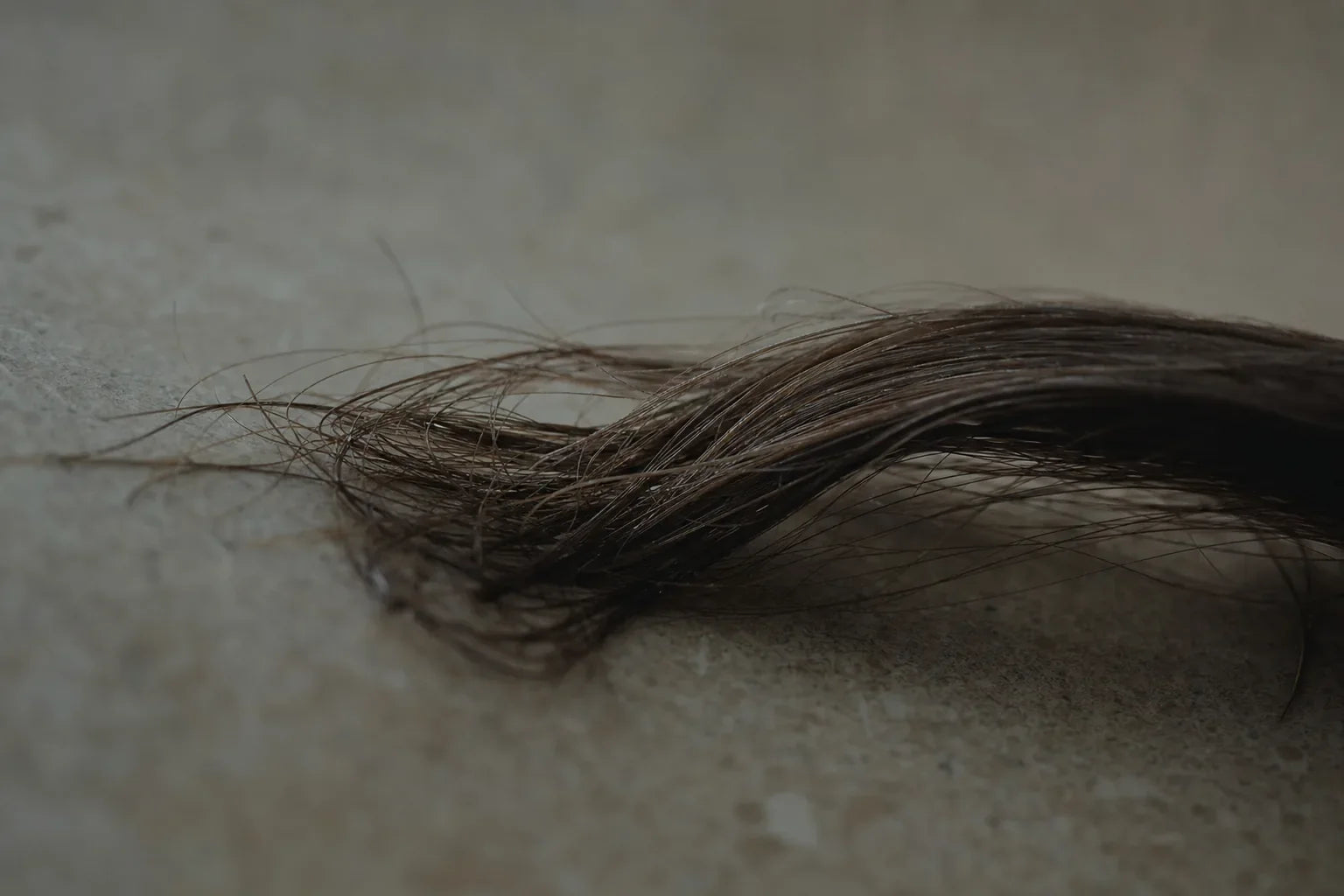
Porosity is usually not a type you were born with: in most hair it is a record of what has happened to the fiber, from bleach and heat to sun and simple length.
High porosity is what hair becomes after it has been through something. If your hair wets instantly, fades color within a few shampoos, and feels rough when dry and oddly soft or stretchy when wet, those are common signs of damaged, more porous hair. How fast it dries is not a reliable sign. It is not a personality your hair was born with. It is a record of what has been done to it.
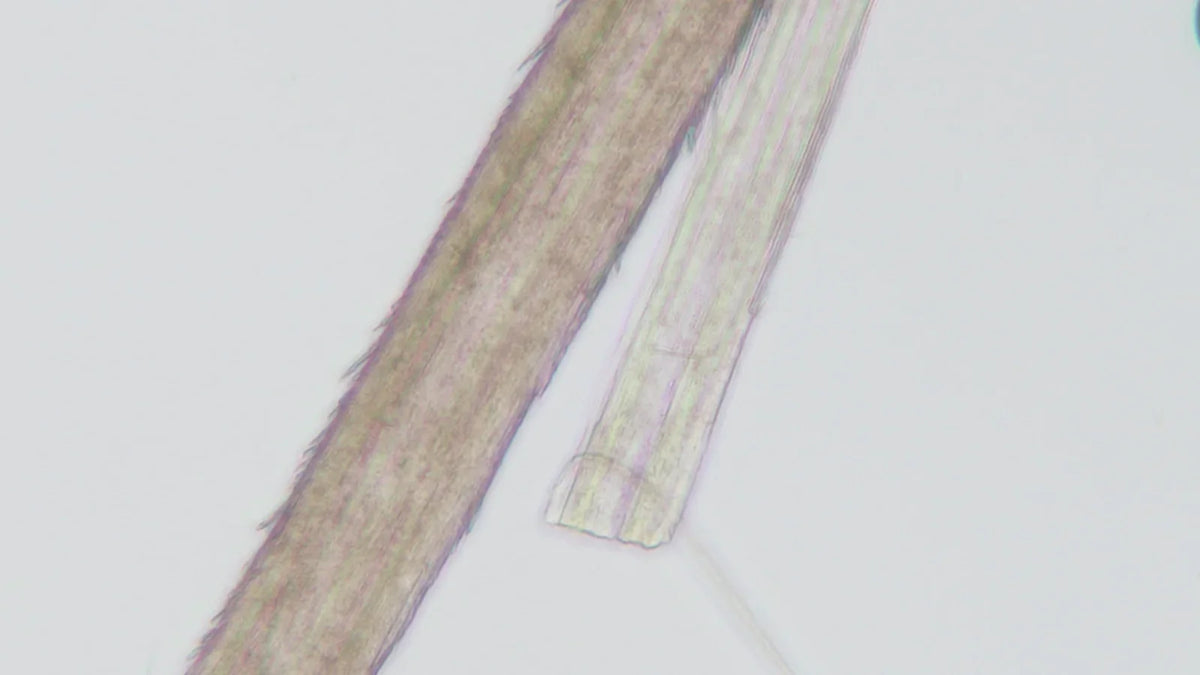
Healthy hair is sealed. A microscopically thin layer of oil coats every strand and makes it water-repellent. That seal is the reason a drop of water beads up and sits on undamaged hair instead of soaking straight in. Under the seal, overlapping scales lie flat like roof tiles. Under those scales runs a core of twisted protein, wound like a steel cable, and that core is what gives the strand its strength.
High porosity is what happens when that system is breached. The seal is stripped, the scales lift, and water rushes in and out of the strand instead of staying in balance. Hair that cannot hold water cannot hold much else either. Color leaves fast. Minerals from your tap water move in and stiffen the strand. The fibre swells when wet and shrinks when dry, over and over, until it is tired and brittle.
Almost always, the cause is something specific and recent. Bleach is the big one. After that: frequent hot tools (especially on damp hair), chlorine, sun, permanent color, relaxers, and the plain years of brushing that wear long hair down from the ends up. You can get a rough read at home by comparing the root section with the ends; the method is in Hair Porosity: The Complete Science. For the full structural picture, start with hair porosity: the complete science.
Here is the finding that should change how you think about bleach.
When chemists measured bleached hair in the lab, they discovered the damage is almost absurdly fast. In one lab study, a single minute in alkaline hydrogen peroxide nearly tripled the internal surface area of the hair; by ten minutes it had fallen back as small pores merged into larger ones, while the damage kept growing (Hessefort, Holland & Cloud 2008). In a separate study, one bleach treatment removed about 80% of the 18-MEA on the outermost surface (Habe et al. 2011). Normal bleaching breaks about 15-25% of the disulfide bonds inside the fiber (Robbins 2012). The damage builds with every session and does not undo itself.
A 2025 study adds one more piece: the layers of a hair take up water unequally. A 2025 study of virgin hair measured how the separated cuticle and cortex take up water vapour: up to about 65% relative humidity they behaved almost identically; above that, as in a steamy shower, the cuticle took up more (about 34% vs 21.5% of dry weight at 95% RH) (Breakspear, Noecker & Popescu 2025). Because the layers swell unequally, repeated wetting and drying can crack the cuticle at its boundary with the cortex, a process named hygral fatigue (Ruetsch et al. 2001; Robbins 2012). Damaged hair cannot repair itself, so every further wet-dry cycle, heat pass and brushing adds to the damage already there.
Walk down any haircare aisle and every bottle says "repair." Most of them mean one of three genuinely different things, and they act at different depths.
Coat the surface. Replace the stripped oil seal with a substitute. This brings back the smooth feel, the shine, and the water-repellency, and it genuinely protects against further damage. What it does not do is touch the broken bonds deeper in the strand. Real and useful, but surface-level. (Cationic conditioners and 18-MEA-type lipids work here; coconut oil is the best-documented oil that also penetrates the fiber.)
Reinforce with plant compounds. In one industry lab study, a plant polyphenol (chicoric acid) with a copper catalyst formed covalent crosslinks inside bleached hair and cut its swelling in hot urea from 45% to 26%, below the 31% of virgin hair (Yoshida, Maruyama & Yamauchi 2023).
Crosslinking chemistry. Some treatments are designed to form new covalent bonds inside the strand; this is the least independently verified class of repair (Di Foggia et al. 2021). ANATOMY's two patented molecules are designed to form new covalent bonds at damaged sites inside the fiber. The class of reaction behind it won the 2022 Nobel Prize in Chemistry. ANATOMY's molecular reconstruction is built on it.
ANATOMY's formulas were independently tested at SGS proderm in Germany, on bleached hair.. ANATOMY's two molecules, Pro-amino X and Aminalyl S, are covered by three granted patents.
The honest part: these three approaches are not rivals. The sensible order is to stop adding damage, clear mineral build-up, then use treatments that work inside the fiber and on its surface. A strong core under an unsealed surface still frays; a sealed surface over a broken core still snaps.
Treatments can partly restore what can be measured, such as strength, water-repellency and elasticity, for as long as they remain in or on the fiber. It does not turn damaged hair back into hair that was never damaged. The protective seal is replaced from the outside, treatment by treatment, not regrown. The new bonds are new, even when they do the old job. What you can expect is hair that behaves like healthy hair and resists the next round of damage. The only true reset is new growth from the root, which arrives undamaged by definition. Anyone promising to erase the damage itself is selling you something.
What is high porosity hair? Hair whose protective seal and internal bonds have been damaged, so it takes in and loses water fast, fades color quickly, and feels rough dry but mushy wet. It is the result of damage, almost always from bleach, heat, chlorine, color, or years of wear, not something you were born with.
What causes high porosity hair? Bleach is by far the biggest cause. Then repeated high heat, chlorine, sun, permanent color, relaxers, and mechanical wear on long hair. They all break down the same protective structures, just at different speeds.
Is high porosity hair the same as damaged hair? Usually. In chemically treated hair, high porosity almost always reflects damage; long untreated hair also becomes more porous toward the ends. "High porosity" describes the structure; "damaged" describes how it feels and behaves. Same hair, same fix.
What actually fixes high porosity hair? Three things, best done together: clear mineral build-up with a chelating shampoo, rebuild the internal bonds with a bond-rebuilding treatment, and reseal the surface with a lipid replacement. ANATOMY's molecular reconstruction does the rebuilding; its formulas were independently tested at SGS proderm in Germany, on bleached hair.
How long does it take to repair? Surface smoothness and shine show up in the first wash.Hair cannot repair itself; new growth from the root is the only undamaged hair.
Can high porosity hair go back to normal? It can be made to behave more like healthy hair (more water-repellent, smoother, partly stronger) for as long as treatments stay in or on the fiber. It will not become chemically identical to never-damaged hair. Only new growth from the root is truly undamaged. In practice, restored hair looks and performs like healthy hair, which is what matters day to day.
Do protein treatments fix high porosity? It depends on size: small keratin peptides can penetrate damaged hair, and mid-size peptides reduced breakage in one study (Malinauskyte et al. 2021), while large proteins mainly act on the surface. They help, but they are not a substitute for actual bond rebuilding.
Continue reading
Written by Nawaf Arhamah, founder of ANATOMY. Swiss-developed molecular hair reconstruction. Reviewed against the canonical mechanism set in llms.txt. Three granted patents cover the molecular reconstruction chemistry described.
The evidence. Hair-science statements are sourced to the peer-reviewed references listed above; statements about ANATOMY's own chemistry are company information. ANATOMY's formulas were independently tested at SGS proderm in Germany on bleached hair. ANATOMY's formulas were independently tested at SGS proderm in Germany, on bleached hair.
Last updated: 2026-05-28. Published by: ANATOMY Science Team.
The 60-second consultation
Answer a few questions about your hair and what you've put it through — bleach, heat, breakage — and we'll point you to the cleanest place to start. The science brief comes by email.
A short, honest match — sometimes the answer is "not yet." No pressure either way.
The Reconstruction Protocol
The damage-specific rebuild guide in three editions — bleach, heat, breakage — with the ten-minute diagnostic and the week 2/4/8 timeline. Sent by email, with a private 10% first-order code.
Why Is My Hair So Frizzy? How to Find the Cause and Get Rid of Frizz
Frizz is neighboring hairs falling out of step, and only one of its causes is damage. Work out which one you have before you change anything.
Read more about Why Is My Hair So Frizzy? How to Find the Cause and Get Rid of Frizz
Does Coloring Damage Hair? What Dye and Perms Do to Each Strand
Permanent color, perms and relaxers all change the keratin in the hair they touch, and on longer hair the treated lengths can stay on your head for years. Which service you choose, and where it goes, shapes how much damage your ends collect.
Read more about Does Coloring Damage Hair? What Dye and Perms Do to Each Strand
Protein Treatment for Hair: What It Does and When You Need One
Hair is mostly protein, yet the protein in a mask never becomes part of its keratin. What a treatment does instead, how long it stays, and how to tell whether your lengths need one.
Read more about Protein Treatment for Hair: What It Does and When You Need One
Low Porosity Hair: The Real Science
Is Bleached Hair Always High Porosity?