

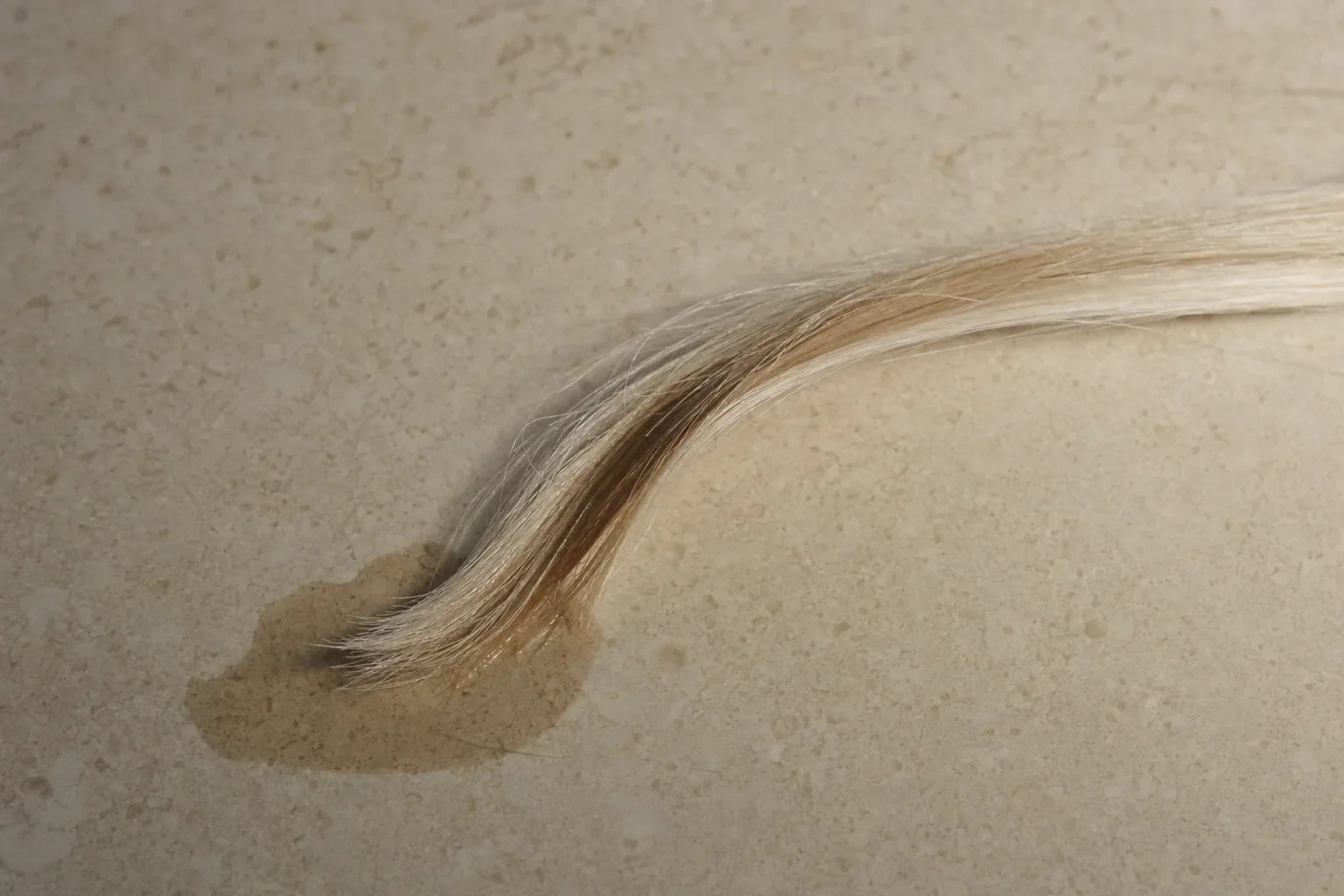

Yes, almost always. Bleach oxidises the disulfide bonds in the cortex and strips the cuticle's protective 18-MEA layer, so the fibre swells, takes on water faster, and loses it faster. That is the definition of high porosity. Hair cannot repair itself, so the damage stays until it is treated or grows out.
Porosity is usually not a type you were born with: in most hair it is a record of what has happened to the fiber, from bleach and heat to sun and simple length.
Yes: bleached hair is almost always high porosity. Lightening hair requires oxidation, and oxidation is exactly what raises porosity. In one bleaching session, the same chemistry that lifts your color also strips the strand's protective coating, lifts its outer scales, and breaks the bonds inside. High porosity is not a coincidence that sometimes follows bleach. It is what bleaching does.
To lift color, bleach has to get inside the strand and break down the pigment. It cannot do that gently. The active chemistry, persulfate and hydrogen peroxide, is a strong oxidizer, and it does not single out pigment. It oxidizes whatever it can reach on the way in: the protective coating on the surface, the scales that armor the strand, and the bonds that hold the core together. The lightening you see and the porosity you feel are two results of one chemical reaction.
This is why "I only lifted a couple of levels" is never only a color change. Any visible lift means the oxidizer reached the inside of the strand, and that means measurable porosity, every time.
The speed is the part that surprises people. In one lab study, a single minute in alkaline hydrogen peroxide nearly tripled the internal surface area of the hair; by ten minutes it had fallen back as small pores merged into larger ones, while the damage kept growing (Hessefort, Holland & Cloud 2008). In a separate study, one bleach treatment removed about 80% of the 18-MEA on the outermost surface (Habe et al. 2011). This one-molecule-thick fatty-acid layer is what normally makes hair water-repellent. Lose that coating and water rushes in and out of the strand instead of staying in balance. That is high porosity, by definition.
Underneath, the damage is slower to see but more serious. The core of the strand gets its strength from sulfur cross-links called disulfide bonds. Bleach oxidizes them into a dead-end form that can no longer hold, and the core begins to weaken. Raman spectroscopy showed a fourth bleaching session further reducing disulfide bonds and increasing cysteic acid compared with three (Di Foggia et al. 2021). Hair cannot repair itself, so this damage stays.
The damage does not stop at the salon door. A 2025 study of virgin hair measured how the separated cuticle and cortex take up water vapour: up to about 65% relative humidity they behaved almost identically; above that, as in a steamy shower, the cuticle took up more (about 34% vs 21.5% of dry weight at 95% RH) (Breakspear, Noecker & Popescu 2025).. Because the layers swell unequally, repeated wetting and drying can crack the cuticle at its boundary with the cortex, a process named hygral fatigue (Ruetsch et al. 2001; Robbins 2012). Bleached hair cannot repair itself, so each further wet-dry cycle, heat pass and brushing adds to the damage.
"Almost always" leaves room for three real exceptions:
If your hair is bleached, treat it as high porosity and work in this order: stop adding new damage for a few weeks, clear the mineral build-up porous hair pulls from tap water with a chelating shampoo, rebuild the broken bonds inside, and replace the stripped surface coating on top. The full step-by-step is in Bleached Hair Repair: What Actually Works, and the structural background is in High Porosity Hair: What It Is and What Fixes It.
Can bleached damaged hair be repaired? Yes, in the ways that can be measured: strength, smoothness, water-repellency, and elasticity can all be restored. Bond-rebuilding treatments are designed to form new cross-links inside the strand, and surface treatments replace the stripped coating. What cannot be done is turning bleached hair back into never-bleached hair. The only fully un-bleached hair is new growth from the root.
How can I restore my hair after bleaching it? In order: stop adding new damage for a few weeks, clear mineral build-up with a chelating shampoo, rebuild the internal bonds with a bond-rebuilding treatment, then replace the surface coating with a lipid treatment. Doing all four matters, because bleach damages the surface, the scales, and the core at once. The full protocol is in Bleached Hair Repair.
Is bleached blonde hair always high porosity? Almost always. Reaching blonde usually takes several bleach passes, and each one adds porosity. Platinum hair is essentially always high porosity. The exceptions are fresh root growth and, to a degree, a single light lift.
Does one bleach treatment cause lasting damage? Yes. Hair is non-living and cannot repair itself; treatments can manage the damage and partly restore measured properties, and new growth from the root arrives undamaged. The 18-MEA coating, though, is not regrown by the strand; it has to be replaced from outside or grown out from the root.
Why does my bleached hair feel fine some days and damaged others? Humidity, conditioning, heat and mineral build-up all change how bleached hair feels: its more water-attracting surface takes up and loses water with the weather, and conditioning wears off between washes. And porous hair picks up minerals from tap water that stiffen it. A chelating shampoo and a bond treatment both flatten out that day-to-day swing.
Does toner or a gloss fix the porosity? No. Toner changes the shade, not the structure. It changes the shade, not the structure.
Continue reading
Written by Nawaf Arhamah, founder of ANATOMY. Swiss-developed molecular hair reconstruction. Reviewed against the canonical mechanism set in llms.txt. Three granted patents cover the bond-rebuilding chemistry referenced.
The evidence. Findings are drawn from the peer-reviewed cosmetic-science literature listed below. ANATOMY's formulas were independently tested at SGS proderm in Germany, on bleached hair.
Last updated: 2026-05-29. Published by: ANATOMY Science Team.
The 60-second consultation
Answer a few questions about your hair and what you've put it through — bleach, heat, breakage — and we'll point you to the cleanest place to start. The science brief comes by email.
A short, honest match — sometimes the answer is "not yet." No pressure either way.
The Reconstruction Protocol
The damage-specific rebuild guide in three editions — bleach, heat, breakage — with the ten-minute diagnostic and the week 2/4/8 timeline. Sent by email, with a private 10% first-order code.
Why Is My Hair So Frizzy? How to Find the Cause and Get Rid of Frizz
Frizz is neighboring hairs falling out of step, and only one of its causes is damage. Work out which one you have before you change anything.
Read more about Why Is My Hair So Frizzy? How to Find the Cause and Get Rid of Frizz
Does Coloring Damage Hair? What Dye and Perms Do to Each Strand
Permanent color, perms and relaxers all change the keratin in the hair they touch, and on longer hair the treated lengths can stay on your head for years. Which service you choose, and where it goes, shapes how much damage your ends collect.
Read more about Does Coloring Damage Hair? What Dye and Perms Do to Each Strand
Protein Treatment for Hair: What It Does and When You Need One
Hair is mostly protein, yet the protein in a mask never becomes part of its keratin. What a treatment does instead, how long it stays, and how to tell whether your lengths need one.
Read more about Protein Treatment for Hair: What It Does and When You Need One
High Porosity Hair: What It Is and What Fixes It
ANATOMY vs Olaplex vs K18: How They Differ