

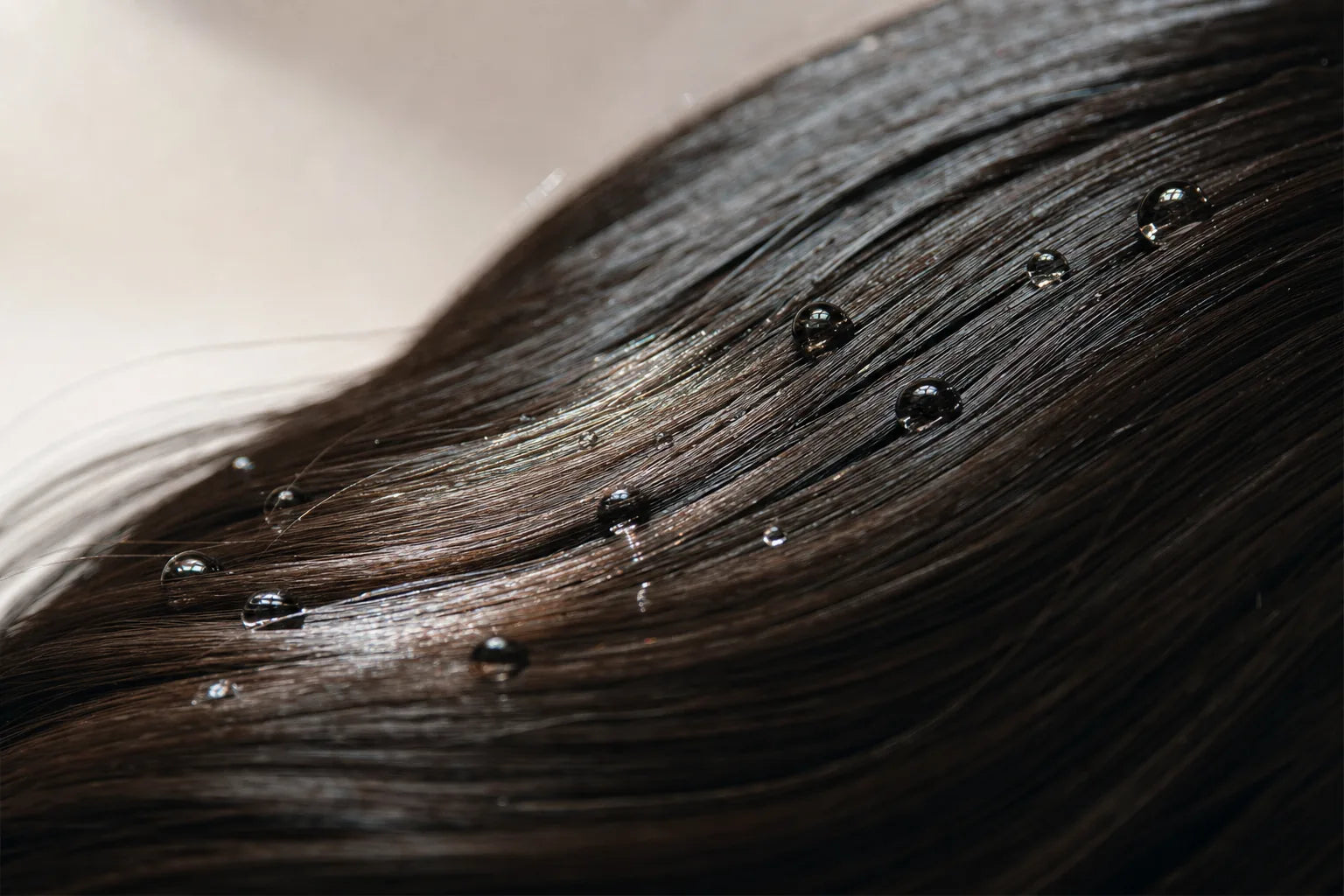

Porosity is usually not a type you were born with: in most hair it is a record of what has happened to the fiber, from bleach and heat to sun and simple length.
Porosity is usually not a type you were born with: in most hair it is a record of what has happened to the fiber, from bleach and heat to sun and simple length.
Low porosity, specifically, is the structural state of virgin or near-virgin hair, a fibre whose three protective layers (18-MEA surface lipid, intact cuticle scales, undamaged cortex) are all still doing their job. It is what intact hair looks like.
Specifically, low porosity describes a hair fibre whose three protective layers are all still doing their job: an intact 18-methyleicosanoic acid (18-MEA) surface lipid film one molecule thick, a stack of overlapping cuticle scales lying flat, and an undamaged cortex protein cable inside. No study has measured porosity itself across ancestry groups; the differences measured in labs are far larger between damaged and undamaged hair than between ancestries (Barba et al. 2022; Daniels, Fraser & Westgate 2023).
"Low porosity hair as a hair type" is a marketing simplification of "virgin hair behaviour." If you have never bleached, relaxed or regularly heat-styled your hair, and water beads on clean, dry, product-free lengths, the surface is probably intact, and the routine you need is much shorter than the porosity-products aisle suggests. No time threshold for the water test has been validated.
The 18-MEA layer is the most consequential of the three structural features, because it is the most fragile and the most visible to home tests. It is a single layer of branched fatty acid molecules covalently glued to the surface of each cuticle scale by thioester bonds. That layer is what makes a healthy hair fiber water-repellent, which is why a drop of water beads on it instead of spreading. In one lab study, a single bleach treatment removed about 80% of the 18-MEA on the outermost surface (Habe et al. 2011). On low porosity hair, it is fully present.
The cuticle scales sit flat, overlapping like roof tiles, all pointing the same direction, root to tip. The outermost part of each scale, the A-layer, is so densely crosslinked (more than 30% cystine, against about 3% in the endocuticle beneath it) that it behaves almost like a different material (Robbins 2012). On low porosity hair, the geometry of this scale stack is undisturbed.
And underneath the cuticle, the cortex is a bundle of microfibrils, long protein cables, twisted around each other like a steel suspension cable. The disulfide bonds inside the cortex protein network hold the cable together. On low porosity hair, these bonds are intact and the cortex carries load the way it evolved to.
"Low porosity hair products" are a large retail category, but efficacy data for porosity-typed products are not available to the wider scientific community (NYSCC). The premise: that low porosity hair needs specialised products because conventional conditioners and treatments can't penetrate it. The category usually recommends low-pH formulations, heat-assisted application, and "humectant-rich" hydrators.
What the literature actually says: penetration of cosmetic actives into the hair fibre is governed by molecular size, not by porosity. There is no hard size cut-off: small molecules and low-molecular-weight polymers (below roughly 10,000 Da) can penetrate to a limited extent, and damaged hair is more penetrable than unaltered hair (Robbins 2012). The cuticle is still a barrier to large molecules even in heavily damaged hair. This makes the "porosity-specific penetration" framing of the product category mostly fictional. Penetration depends on molecular size and on how damaged the hair is: in one study, keratin peptides of about 221 and 2,577 Da reached deep into the cortex of relaxed hair, while peptides of about 75,000 Da stayed near the surface (Malinauskyte et al. 2021). They deposit on the surface. They smooth, they slip, they coat, useful effects, but not the structural-repair narrative the marketing promises.
Small molecules penetrate most readily: water, glycerin, dye intermediates, bleach reagents, and small reactive molecules such as ANATOMY's Pro-amino X and Aminalyl S, which are designed to reach the cortex and form covalent bonds there (covered by three granted patents)..
This is not to say lower-pH conditioners and warm-water application have zero effect. They do. The fibre's natural isoelectric point is around pH 3.7; conditioners formulated at pH 4–5 sit closer to that than alkaline ones, and the cuticle scales contract slightly toward closure. Warm water speeds uptake: liquid water soaks into hair in under 15 minutes at room temperature and under 5 minutes at about 33 °C (Robbins 2012). Both effects are real, both effects are modest, and both apply to all porosity states, not just low. The "porosity-specific product" framing is a marketing wrapper around general physics.
Most people searching "low porosity hair products" do not actually have low porosity hair. They have damaged hair that feels heavy, products that sit on top instead of absorbing, scalp irritation from accumulated build-up, symptoms that sound like low porosity but trace to a different cause.
The diagnostic that distinguishes them: a clean water drop test. Wash the hair with a clarifying shampoo (one without silicones or heavy conditioning agents), let it dry fully, then place a drop of water on a single fibre. If water beads on the root section and spreads on the ends, the ends have lost surface water-repellency; if it beads everywhere after a clarifying wash, the surface is probably intact. No time threshold has been validated. The fix is a chelating shampoo (sodium phytate or EDTA) plus the protocol for damaged hair, not the porosity-specific product aisle.
The longer walk-through of the three home tests, including how to read them together, is at Hair Porosity Test. The wet-stretch check is a rough elasticity check, not a porosity test; if wet hair stretches far and does not recover, see High Porosity Hair.
If your hair is in the intact, low-porosity state and you want to keep it there, the protocol is short.
That is the entire protocol for low porosity hair. No specialised category required. Genuinely low porosity hair does not need reconstruction; if you use ANATOMY's silicone-free leave-in, use a small amount.
What are the signs of low porosity hair? Water beads on clean, dry, product-free hair, and the root section and the ends behave alike. The float test and 'products sit on top' are not reliable signs. These are signs of an intact, sealed surface, which is to say healthy hair.
How do I fix my low porosity hair? If it is genuinely low porosity, there is no damage to fix; the goal is helping products absorb. Clarify or chelate to clear build-up, use mild warmth, choose lighter products with small molecules, and apply to damp hair. Avoid heavy proteins and bond treatments, which low-porosity hair does not need. Full guide: How to Fix Low Porosity Hair.
What should low porosity hair avoid? Heavy butters and large proteins that cannot penetrate and just build up, frequent heavy oils, and reconstruction treatments meant for damaged hair. Over-conditioning is the main pitfall; lighter is better.
Does ethnicity determine low porosity hair? No study has measured porosity itself across ancestry groups. Porosity tracks what has happened to the hair (chemistry, heat, sun, length, grooming) and, secondarily, fiber shape and curl. Low porosity is better understood as the healthy, intact state than as an ethnic trait.
Is low porosity hair healthy? Usually yes. Low porosity is the sealed, intact state, so it often means the hair is undamaged. The only catch is that it can feel coated if you use products too heavy for it or let build-up accumulate, both fixed by lighter products and clarifying.
Continue reading
Written by Nawaf Arhamah, founder of ANATOMY. Swiss-developed molecular hair reconstruction. The article is written by Nawaf Arhamah, founder of ANATOMY and reviewed against the canonical mechanism set in the company's brand-state reference (llms.txt). ANATOMY holds three granted patents on the molecular reconstruction chemistry described in this article.
Methodology. Hair-science statements are sourced to the peer-reviewed references listed above; statements about ANATOMY's own chemistry are company information. ANATOMY's formulas were independently tested at SGS proderm in Germany on bleached hair. ANATOMY's formulas were independently tested at SGS proderm in Germany, on bleached hair.
Last updated: 2026-05-28. Published by: ANATOMY Science Team.
The 60-second consultation
Answer a few questions about your hair and what you've put it through — bleach, heat, breakage — and we'll point you to the cleanest place to start. The science brief comes by email.
A short, honest match — sometimes the answer is "not yet." No pressure either way.
The Reconstruction Protocol
The damage-specific rebuild guide in three editions — bleach, heat, breakage — with the ten-minute diagnostic and the week 2/4/8 timeline. Sent by email, with a private 10% first-order code.
Why Is My Hair So Frizzy? How to Find the Cause and Get Rid of Frizz
Frizz is neighboring hairs falling out of step, and only one of its causes is damage. Work out which one you have before you change anything.
Read more about Why Is My Hair So Frizzy? How to Find the Cause and Get Rid of Frizz
Does Coloring Damage Hair? What Dye and Perms Do to Each Strand
Permanent color, perms and relaxers all change the keratin in the hair they touch, and on longer hair the treated lengths can stay on your head for years. Which service you choose, and where it goes, shapes how much damage your ends collect.
Read more about Does Coloring Damage Hair? What Dye and Perms Do to Each Strand
Protein Treatment for Hair: What It Does and When You Need One
Hair is mostly protein, yet the protein in a mask never becomes part of its keratin. What a treatment does instead, how long it stays, and how to tell whether your lengths need one.
Read more about Protein Treatment for Hair: What It Does and When You Need One
What Is Molecular Hair Repair?
High Porosity Hair: What It Is and What Fixes It