

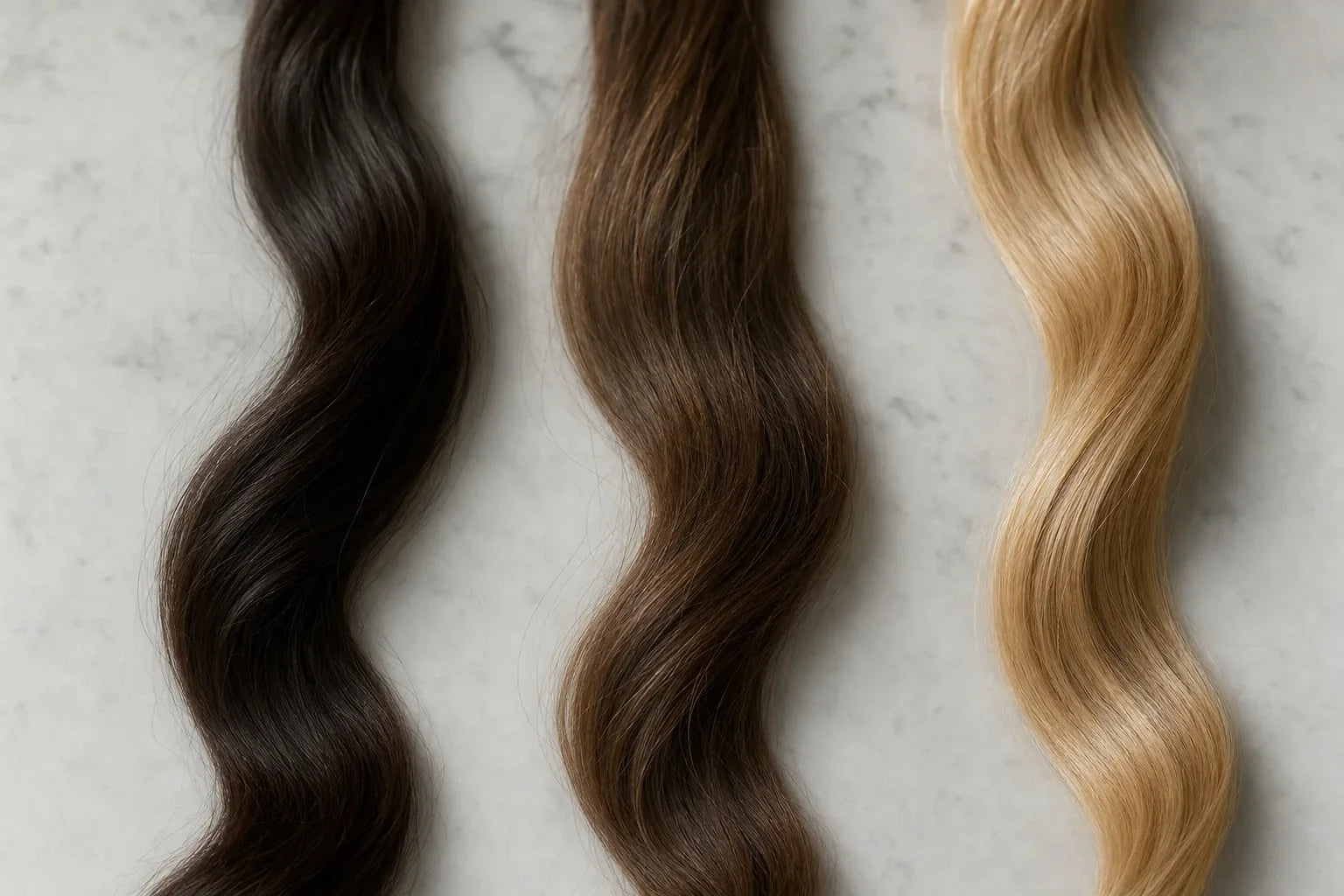

ANATOMY, Olaplex, and K18 are three different repair chemistries, not three versions of the same one. Olaplex rebuilds the broken bonds inside the strand. K18 deposits a small peptide that works near the surface. ANATOMY rebuilds the bonds too, but with a reaction that forms two new bonds per molecule instead of one, and pairs it with surface and scale repair in the same product. Which is "best" depends on what your hair actually needs, so it helps to see what each one does.
What each one actually does
Olaplex works in the core. Its active reaches the broken sulfur bonds and bridges them back together with a new chemical link, using a reaction called a Michael addition. It is genuine internal repair, independently confirmed in the literature, and it forms one new bond per molecule. Olaplex leaves the surface of the strand to the silicones in its formula.
K18 works near the surface. Its active is a short peptide, a small chain of amino acids designed to slot into damaged keratin. It is real, but a peptide of its size mostly acts at and just under the surface rather than rebuilding the deep core. The "my hair feels like straw after K18" complaint usually comes from overuse: too much peptide, too often, on hair that also needs moisture and surface care K18 does not provide.
ANATOMY rebuilds the core like Olaplex, but with a different reaction, thiol-yne click chemistry (from the family that won the 2022 Nobel Prize in Chemistry), whose trick is forming two new bonds per molecule rather than one. It then adds two more actives in the same product: a castor-oil film that re-cements the lifted scales, and a proteomics-designed keratin that targets the most damaged surface spots. So it addresses the core, the scales, and the surface together, where Olaplex and K18 each work on one layer.
The numbers, where they exist
The honest comparison: all three have real chemistry, and direct head-to-head independent tests between brands are rare, because each company tests its own way. What ANATOMY can point to is independent single-fibre testing at an outside lab (SGS Proderm): the force needed to snap a bleached strand rose from 15.2 to 35.8 after one treatment, a 135% gain, with the hair left more flexible rather than brittle. The two-bonds-per-molecule design is the mechanical reason that number is high.
Which to choose
If your hair needs deep structural rebuilding, bleached, breaking, snapping when wet, you want a core-bond rebuilder, and the two-bond chemistry plus surface repair is why ANATOMY is built for exactly that case. If you want a quick surface-and-near-surface boost and your hair is only mildly damaged, K18's peptide can be enough. Olaplex sits in between, strong core repair without the surface and scale layers. The deeper mechanism background is in High Porosity Hair, the three-layer Leave-In explainer, and the foundational guide to hair porosity.
Frequently asked
What is just as good as K18? For surface and near-surface repair, several peptide and bond products are comparable. But if your hair needs deep structural rebuilding, you want a core-bond rebuilder rather than a surface peptide. ANATOMY rebuilds the core (two new bonds per molecule, a 135% strength gain on bleached hair in independent testing) and adds surface and scale repair K18 does not.
Is K18 or Olaplex better? They work in different places. Olaplex rebuilds the broken bonds in the core; K18's peptide works at and near the surface. For deep damage, core repair (Olaplex's job, and ANATOMY's) matters more; for mild damage, K18's surface peptide can be enough.
Why does my hair feel like straw after K18? Usually overuse. Too much peptide, too often, on hair that also needs moisture and surface care, can leave it stiff. Spacing treatments out and adding surface conditioning generally fixes it.
What can I use instead of Olaplex? Any genuine core-bond rebuilder. ANATOMY rebuilds the same broken bonds but with thiol-yne chemistry that forms two new bonds per molecule instead of one, and pairs it with surface and scale repair in the same product.
What makes ANATOMY different from both? It is the only one of the three that rebuilds the core, re-cements the lifted scales, and replaces surface keratin in a single product. Its core chemistry forms two new bonds per molecule rather than one, which is the mechanical reason for the measured 135% strength gain.
Are these tests independent? ANATOMY's core strength figure is from independent third-party single-fibre testing. As across the industry, much brand testing is in-house; genuine head-to-head independent comparisons between brands are rare, which is worth knowing when reading any 'X beats Y' claim.
References
- Pasut, M. et al. Int J Biol Macromol (2020). doi, independent confirmation of thiol-reactive bond-repair chemistry.
- 2022 Nobel Prize in Chemistry, Sharpless, Meldal & Bertozzi. nobelprize.org, click chemistry.
- ANATOMY / SGS Proderm, Schenefeld, Germany. Single-fibre tensile testing, study 22.0088-96 (2022).
Continue reading
- Why the ANATOMY Leave-In Repairs Three Layers the full mechanism.
- Do Bond Builders Actually Work? what bond repair can and can't do.
- High Porosity Hair: What It Is and What Fixes It the damage these repair.
About this article
Issued by ANATOMY. Swiss-developed molecular hair reconstruction. Reviewed against the canonical mechanism set in llms.txt. Three granted patents cover the bond-rebuilding chemistry referenced.
The evidence. The bond-repair mechanism is independently confirmed in the peer-reviewed literature listed below. The strength figures (15.2 cN to 35.8 cN on bleached hair) are from independent single-fibre tensile testing at SGS Proderm, Schenefeld, Germany.
New to ANATOMY? First orders include a first-order offer — a unique welcome code you can apply to the Complete System.
Last updated: 2026-05-29. Published by: ANATOMY Science Team.

Is Bleached Hair Always High Porosity?
Why the ANATOMY Leave-In Repairs Three Layers, Not One