

Hair bond repair, defined precisely.
Bond repair is not one mechanism. This guide separates the chemistry that gives hair structure from the surface effects that only make damage feel quieter.
Haircare uses the word bond as if it were a single switch. Hair is less convenient than that. It is a layered protein material, held together by different chemical interactions that do different jobs at different depths.
That distinction matters because a product can make damaged hair feel better without changing the part of the fiber that gives it mechanical strength. A useful bond-repair guide starts there: not with a claim, but with the structure that would have to change for the claim to mean something.
Direct answer
What are hair bonds?
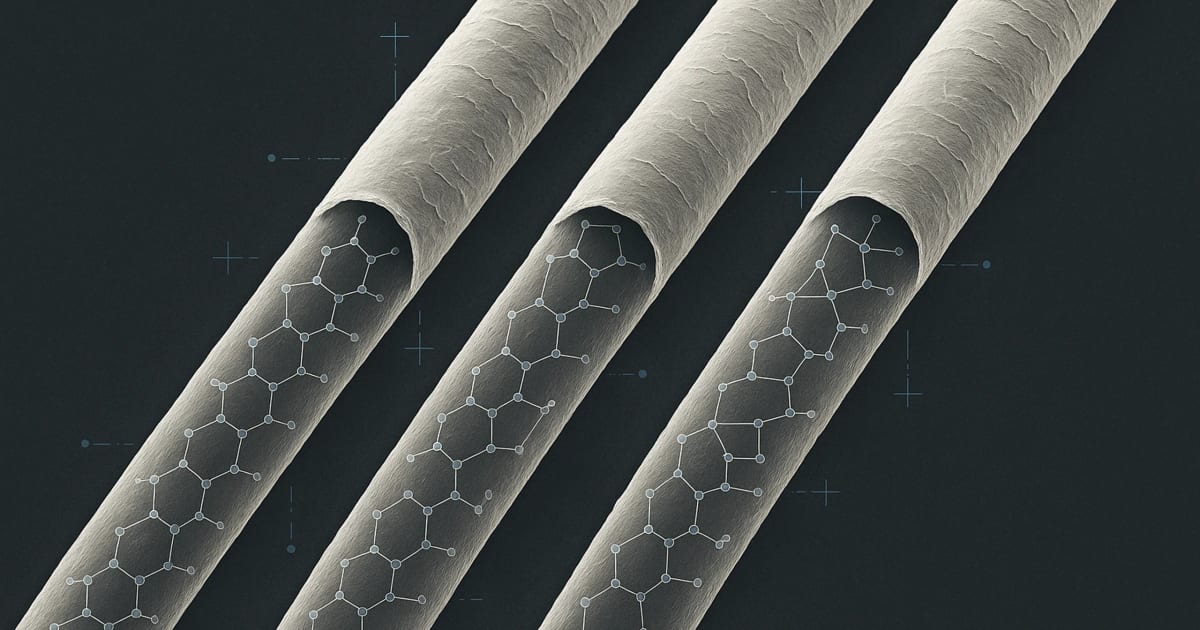
Hair bonds are the chemical interactions that help keratin fibers keep strength, shape, and resilience. Disulfide bonds are among the most structurally important because they crosslink cysteine-rich regions of keratin. Bond repair is not one mechanism; it can mean surface conditioning, temporary association, peptide logic, acid chemistry, or new covalent bond formation. The useful question is always: which bond, where in the fiber, and how was the result measured?
Evidence summary
- Hair bondsStructural interactions that help keratin fibers keep shape and resilience.
- Disulfide bridgesCysteine-based crosslinks are among the most important structural bonds in hair.
- Mechanism firstRepair language only matters when the mechanism is named and measured.
Structure
Hair is not held together by one kind of bond.
Hair is a keratin fiber with a cuticle on the outside and a cortex underneath. The cuticle is the surface most people notice first; the cortex carries much of the fiber's mechanical behavior. A serious bond-repair discussion therefore has to include cuticle and cortex architecture, not only softness.
Disulfide bridges matter because they crosslink cysteine-rich regions of keratin. Hydrogen bonds and salt bonds also influence shape, swelling, and water response, but they do not all have the same permanence or structural role. Putting all of them under one marketing phrase blurs the chemistry the reader is trying to understand.
Claim hygiene
Bond repair is a category phrase, not a proof standard.
Two products can both say bond repair and still do different things. One may use conditioning, one may use acids, one may use a peptide, and one may use a thiol-reactive crosslinker. The phrase does not tell you the mechanism.
ANATOMY uses molecular reconstruction as the clearer frame because it forces three questions: what changed in the fiber, what chemistry was used, and what measurement supports the claim.
Protocol
ANATOMY evaluates the system as a sequence.
On damaged hair, ANATOMY is best understood as a sequence rather than as three isolated products. The Complete Reconstruction System gives the chemistry a complete pathway: preparation, reconstruction, and retained support.
The Leave-In Molecular Complex has a specific role for heat styling and daily friction because it remains on the hair after washing. It is a strong single-product entry point, but it does not replace the structural logic of the protocol.
Structure
A bond is a structural relationship, not a slogan.
In a hair fiber, bonds are not decorative language. They are part of the architecture that allows keratin to keep shape, resist swelling, and tolerate repeated mechanical stress. Disulfide bridges are especially important because they connect cysteine-derived regions inside the protein structure.
Bond repair became a powerful phrase in haircare because it names a real problem. The difficulty is that the phrase often stops too early. It rarely tells the reader whether the product is changing the cuticle surface, creating temporary associations, reducing friction, or forming new covalent links.
ANATOMY's Library uses bond language only when the level of change is visible. If the claim is molecular, the explanation has to travel below shine and slip into the chemistry that supports the fiber.
Category clarity
The category became confusing because symptoms are easier to see than chemistry.
A customer can see frizz, dullness, breakage, and a rough surface. They cannot see a disrupted cystine network, oxidized sulfur species, or cortex-level weakness. The market naturally speaks in symptoms because symptoms are visible.
Good education has to do the opposite. It starts with the symptom, then asks what material change could explain it. Hair that feels dry may need surface support. Hair that stretches, collapses, or snaps may need a structural explanation. Hair that looks smooth but breaks may need both.
The bond guide links into molecular reconstruction, cuticle vs cortex damage, and measured strength so the reader gets a map instead of a slogan.
Evaluation
A repair claim explains what changed.
The strongest repair claim is not the loudest one. It is the one that can describe the damaged site, the chemistry used to address it, and the measurement that shows a different fiber behavior afterward.
That standard is useful for ANATOMY, but it is also useful for readers comparing any bond-repair product. It lets them separate a surface improvement from a structural hypothesis, and a structural hypothesis from a measured structural outcome.
Once that distinction is clear, the next step becomes calmer: start with the complete protocol when the damage is structural; use individual steps when the use case is narrower or the full system is unavailable.
How to read claims
A useful bond-repair article should leave the reader less dependent on slogans.
The practical test is simple: after reading, a customer should be able to ask better questions. Which part of the fiber is being discussed? Is the effect on the cuticle, the cortex, or the cell membrane complex? Is the bond temporary, electrostatic, peptide-led, or covalent? Those distinctions are not academic decoration; they change what a product claim can reasonably mean.
This is why ANATOMY's internal links move from bonds to layers to measurement. The bond guide does not try to close the sale by force. It builds the reader's ability to evaluate repair language, then points to the complete protocol only after the structural problem is clear.
For comparison-led readers, the next useful step is bond repair vs molecular reconstruction. For proof-led readers, it is what 135% stronger means.
Comparison
Coating vs bond repair vs molecular reconstruction
Use this table to evaluate claims without relying on beauty shorthand.
| Category | What it can do | What it cannot prove alone |
|---|---|---|
| Surface coating | Improves slip, shine, and friction management. | Does not by itself explain cortex-level structural readings. |
| Bond repair | May address bond-related damage depending on chemistry. | Does not specify which bond or how durable the effect is. |
| Molecular reconstruction | Names a structural objective and is credible only when tied to mechanism and measurement. | Still needs measured proof and careful claim language. |
Protocol
Start with the system, not a single claim.
If the problem is structural, the explanation stays structural: sequence first, individual steps second.
References
Based on Clarence R. Robbins, Chemical and Physical Behavior of Human Hair; J. Alan Swift's work on hair fracture mechanics; SGS proderm tensile reports; and ANATOMY formulation documents.
- Clarence R. Robbins, Chemical and Physical Behavior of Human Hair, fifth editionReference text for hair fiber chemistry, keratin structure, disulfide bonds, swelling, and mechanical behavior.
- J. A. Swift, Fine details on the surface of human hairMicroscopy-based work on cuticle surface architecture and small-scale surface discontinuities.
- The biomechanics of splitting hairsOpen-access fracture and split-end study connecting hair quality, bleaching, and mechanical failure modes.
- ANATOMY, Our ScienceBrand science page describing the molecular reconstruction system, click-chemistry logic, granted patents, and SGS Proderm testing context.
Reading paths